
When you are staring at a soggy lawn or a damp basement wall, you know you need a solution. For millions of American homeowners, that solution is a French drain. This simple yet ingenious system popularized in 1859 by Henry Flagg French has been keeping properties dry for over a century.
However, knowing what you need is only half the battle. The success of a French drain hinges entirely on its installation, and one question consistently stumps DIYers and inexperienced contractors alike: How deep should it be?
Dig too shallow, and you might as well be burying money in the mud. Dig too deep without a plan, and you risk damaging your foundation or hitting utility lines. At Ware Landscaping, we believe in getting it right the first time. In this guide, we’ll explore the ideal depths for different drainage scenarios, how soil and climate dictate your digging strategy, and why depth is just one piece of the puzzle.
The Short Answer
If you are looking for a general rule of thumb, most residential French drains in the United States are installed at a depth of 18 to 24 inches.
This “sweet spot” is deep enough to collect subsurface water before it saturates the topsoil, yet shallow enough to allow for manageable excavation and maintenance. For the average backyard dealing with soggy grass or minor pooling, this depth allows the perforated pipe and gravel to effectively intercept water and channel it away.
But as with any construction project, the “average” doesn’t apply to everyone. Your specific depth requirement will vary based on three critical factors: What you are trying to dry out, where you live, and what kind of soil you are digging into.
Factor 1: The Goal of the Drain
The most important variable is the problem you are solving. Are you dealing with surface puddles or deep structural seepage?
Surface Water Management (Shallower)
If your primary issue is standing water in low spots of your lawn after a heavy rainstorm, you are dealing with surface water. In these cases, a shallower trench—sometimes as shallow as 8 to 12 inches—can be effective. These “curtain drains” or surface drains are designed to catch runoff quickly before it has a chance to soak in.
Groundwater and Foundation Protection (Deeper)
If you have a wet basement, the stakes are higher. You are fighting groundwater and hydrostatic pressure. To protect a foundation, the drain must be installed below the basement floor level or alongside the footing. This often requires excavating 24 to 48 inches deep sometimes even more. If the drain is shallower than the floor it is meant to protect, the water will simply flow under the pipe and continue seeping into your home.
Factor 2: Soil Composition
The dirt in your backyard dictates how water moves. Understanding your soil type is crucial for determining how deep (and wide) your trench needs to be.
- Clay Soil (The South and Midwest): Heavy clay soils, common in states like Georgia, Texas, and Ohio, hold water tightly and drain slowly. In these environments, a shallow drain might get overwhelmed. We often recommend digging deeper-24 to 36 inches-to get below the densest clay layers and encourage better percolation.
- Sandy Soil (Coastal and Desert Regions): Sandy soil drains naturally and quickly. In areas like Florida or parts of Arizona, a standard 12 to 18-inch depth is usually sufficient because the water can easily travel through the soil to reach the pipe.
Factor 3: Climate and the Frost Line
For homeowners in northern states like Minnesota, New York, or Michigan, winter brings a unique challenge: the frost line.
When water freezes, it expands. If your French drain is located above the frost line, the water inside the pipe or gravel can freeze, effectively blocking the system right when you need it most (during a thaw). Worse, the expansion can heave the pipe out of alignment.
In these colder regions, critical drainage systems especially those protecting foundations must be placed below the frost line, which can range from 36 to 60 inches deep depending on local building codes. While shallow yard drains may survive a freeze (as they are usually dry in winter), foundation drains cannot afford to fail.
Installation Basics
Once you have determined the depth, the installation process requires precision. A functional French drain is a system, not just a ditch.
- Safety First: Before a shovel hits the dirt, you must call 811 to have underground utilities marked. Digging blindly at depths of 18+ inches puts you at risk of hitting gas, electric, or water lines.
- The Slope: A deep hole is useless if it’s perfectly flat. Your drain must have a continuous downhill slope of at least 1% (a 1-inch drop for every 10 feet of length). This ensures gravity pulls the water to your discharge point.
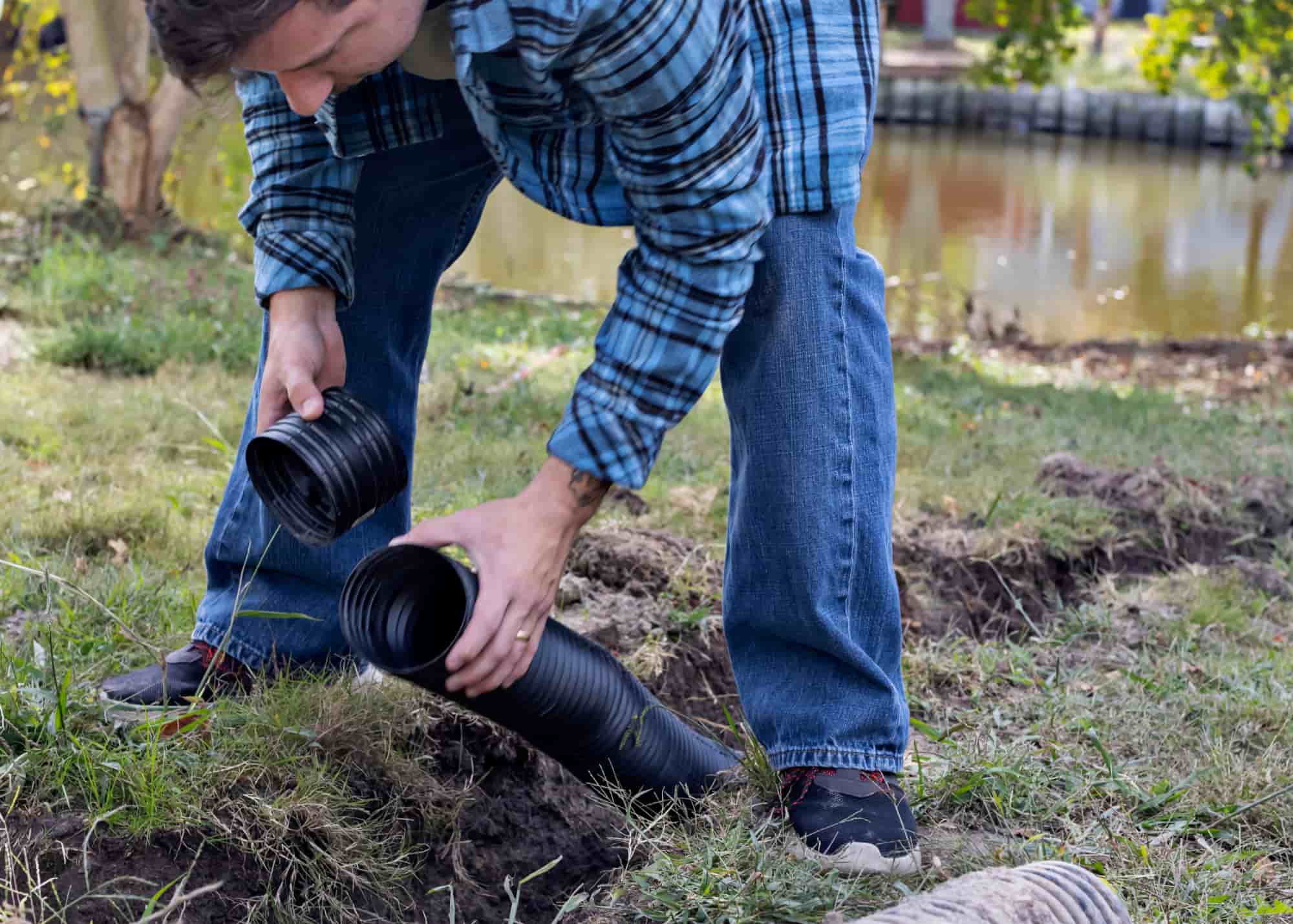
- The “Burrito” Method: We line the trench with heavy-duty non-woven geotextile fabric. Next, we add a 2-3 inch base of washed gravel, lay the 4-inch perforated PVC pipe (holes facing down!), and cover it with more gravel. Finally, the fabric is wrapped over the top to seal the gravel in. This prevents soil from silting up the stone voids while allowing water to pass through.
Common Mistakes
We often get called to fix DIY French drains that stopped working after a year. The culprit is almost always depth-related or material-related.
- Too Shallow: A drain installed 6 inches deep might hide the pipe, but it won’t lower the water table. The grass above might look dry, but the soil just inches below remains a swamp.
- Following the Terrain, Not the Level: Just because your yard looks flat doesn’t mean your trench should be. If the trench follows the undulations of the ground surface rather than a strict downward grade, you will create underground pockets of standing water.
- Ignoring the Discharge: You can dig the perfect 24-inch trench, but if it doesn’t daylight (exit) at a lower point or empty into a dry well, you have just built a moat, not a drain.
When to Call the Professionals
Digging a trench that is 100 feet long and 24 inches deep involves moving tons of heavy, wet earth. It requires laser levels to ensure slope, knowledge of local building codes to ensure legality, and the physical capacity to handle heavy gravel and piping.
While a shallow surface drain can be a weekend project for a dedicated DIYer, deep drainage solutions especially those near foundations or in difficult clay soil—are best left to experts.
At Ware Landscaping, we don’t just dig holes; we engineer solutions. We assess your soil type, calculate the necessary hydraulic gradient, and install systems designed to last decades, not seasons. Whether you need to protect your basement from the next big storm or simply want to reclaim your soggy backyard, we have the experience to determine exactly how deep we need to go to keep you dry.
Don’t guess with your home’s foundation.
Contact Ware Landscaping today for a professional drainage assessment. Let us do the digging so you can enjoy the results.