
A wet yard can be surprisingly expensive. You pay for reseeding muddy patches, replacing plants that cannot tolerate soggy soil, and trying temporary fixes each spring. If stormwater heads toward the house, the potential consequences are more serious. But paying for the wrong drain is no better than doing nothing. A French drain is only useful when it intercepts the right water and carries it somewhere that can accept it.
This guide explains how much a French drain costs, shows realistic price examples, separates material costs from installation costs, and explains where homeowners in Naperville and the wider Chicago area should expect their estimates to differ from online averages. You’ll also learn when a French drain is the right choice—and when grading, catch basins, a dry well, or a pump-assisted system may be a smarter investment.
French drain cost at a glance: 2026 prices
The biggest price distinction is where the drain goes and how deeply crews must dig. A shallow trench in open lawn is not comparable with a drain installed alongside a foundation or beneath a basement floor.
| French drain type | Typical installed cost per linear foot | Illustrative project cost | Primary purpose |
|---|---|---|---|
| Shallow surface-level yard drain | $10–$30 | $500–$5,300 | Manage surface water in an accessible yard |
| Curtain drain in yard | $10–$35 | $1,500–$8,800 | Intercept water moving through shallow soil |
| Deep exterior footing/perimeter drain | $30–$90 | $4,500–$22,500 for roughly 150–250 feet | Capture water beside a foundation |
| Interior basement perimeter drain | $40–$85 | $4,000–$17,000 | Collect basement seepage, usually with a sump pump |
| Interior crawl-space drain | $20–$40 | $2,000–$8,000 | Control moisture in an accessible crawl space |
These are U.S. reference ranges reported by HomeGuide in February 2026, not Ware Landscaping’s fixed prices. Project costs are drawn from different sample lengths and scopes; do not compare them as if each row covers exactly 100 feet. Estimates exclude unusual site conditions or separate repair work unless specified.
The phrase “French drain cost per foot” can make drainage projects look more standardized than they really are. Two 80-foot systems can have entirely different prices. One might cross a flat grass lawn and discharge at a permitted outlet downhill. Another might need deeper excavation, a buried line around existing utilities, a collection basin, and landscaping restoration. The expensive part is often making the water travel safely—not simply buying more pipe.
What does a French drain do, and what are you actually paying for?
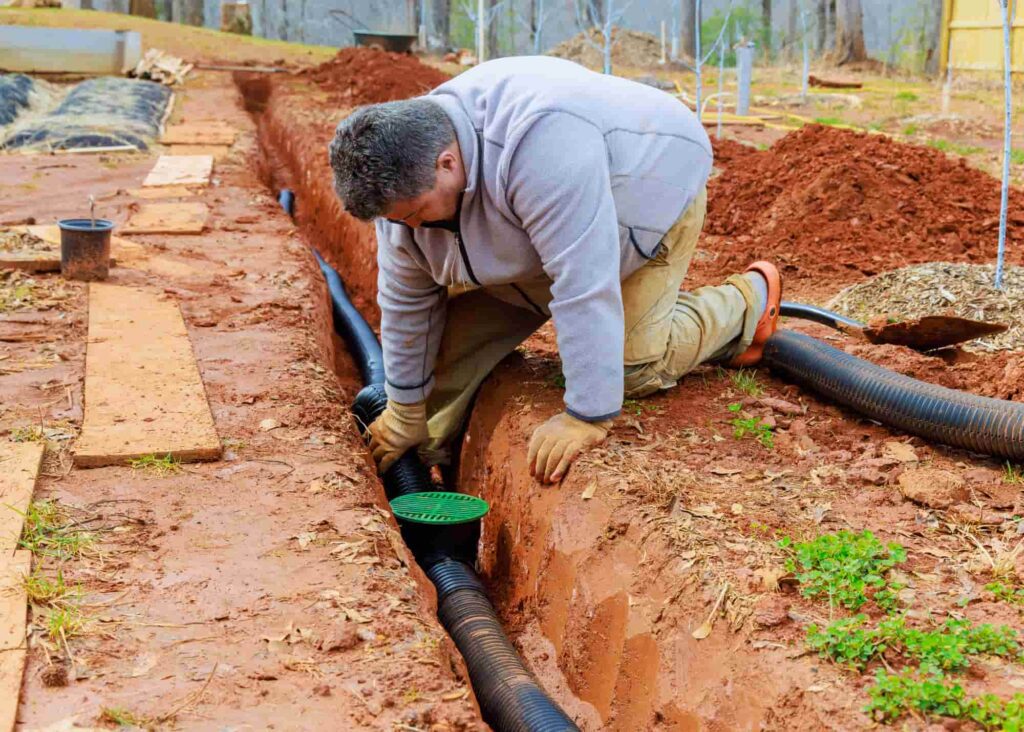
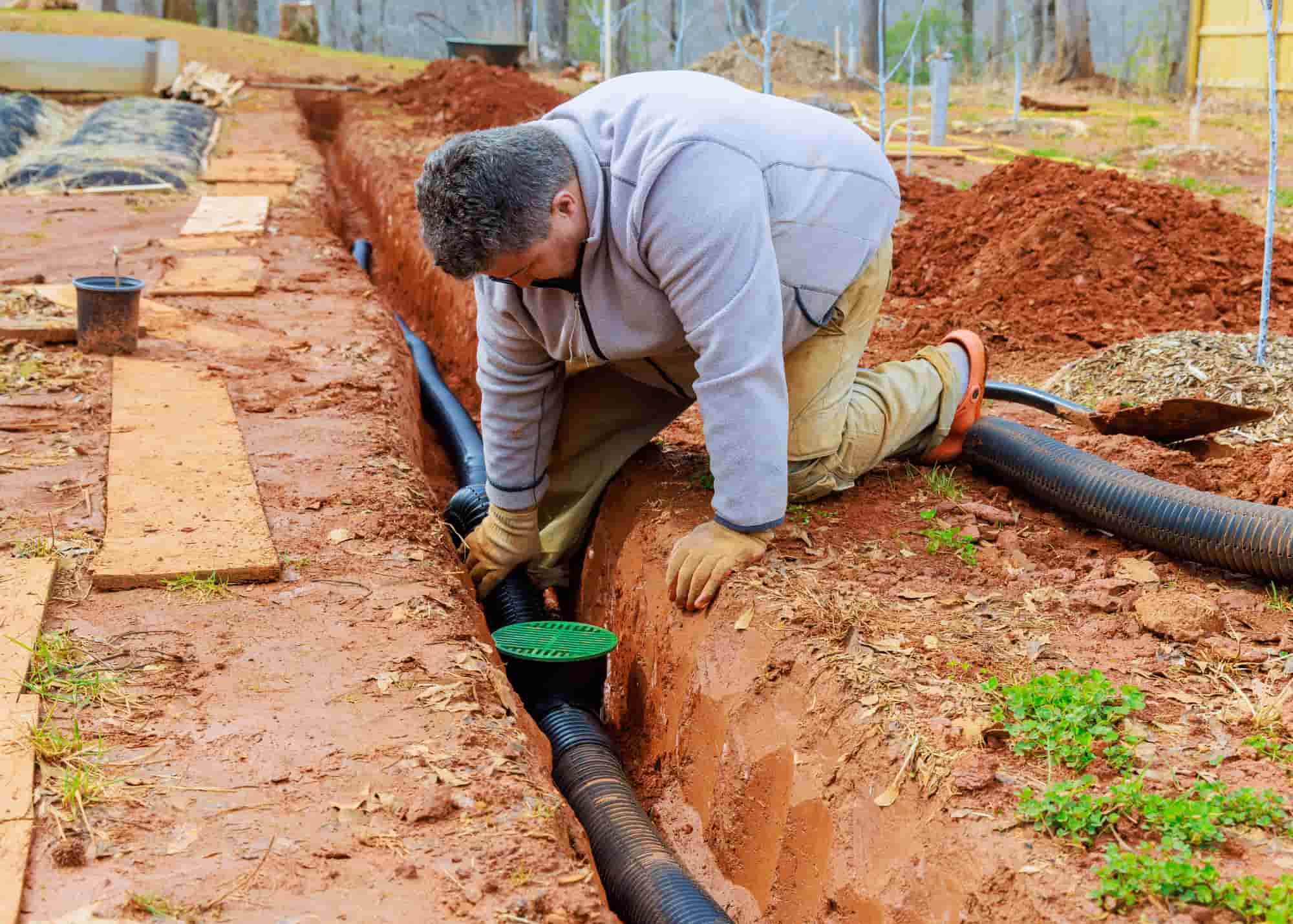
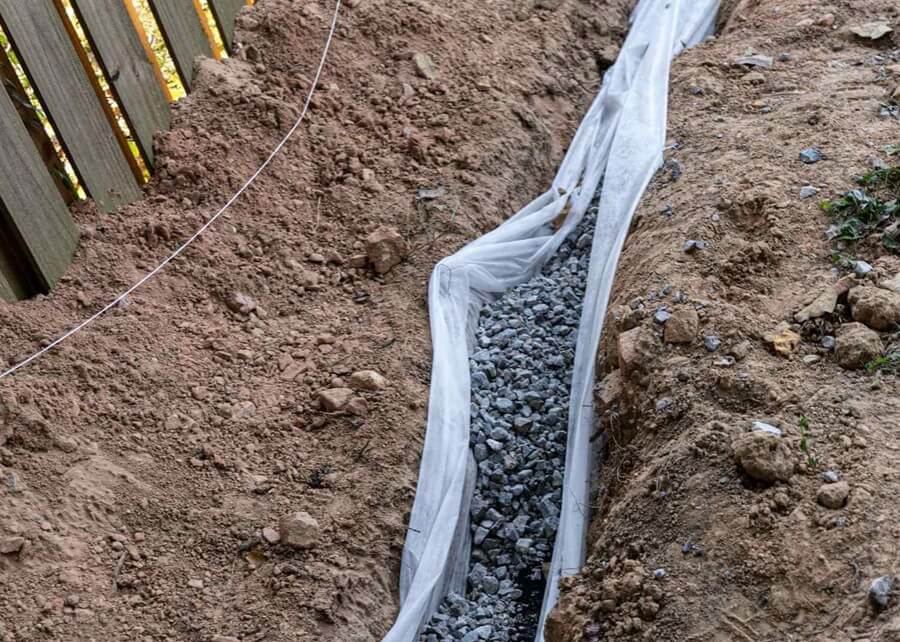
A French drain typically consists of a trench containing washed drainage stone and, in many modern installations, perforated pipe. Water enters the stone-filled zone, passes into the pipe, and follows the pipe or trench gradient toward a suitable outlet. A geotextile fabric can help separate the surrounding soil from the drainage aggregate, reducing sediment migration when correctly specified.
A properly planned system has three essential parts: collection, conveyance, and discharge. The collection area must reach the water you’re trying to intercept. The pipe must have sufficient capacity and a workable slope or connect to a designed pumping system. Finally, the outlet must be both functional and allowed under applicable local rules. If any part is missing, installing more pipe will not necessarily improve drainage.
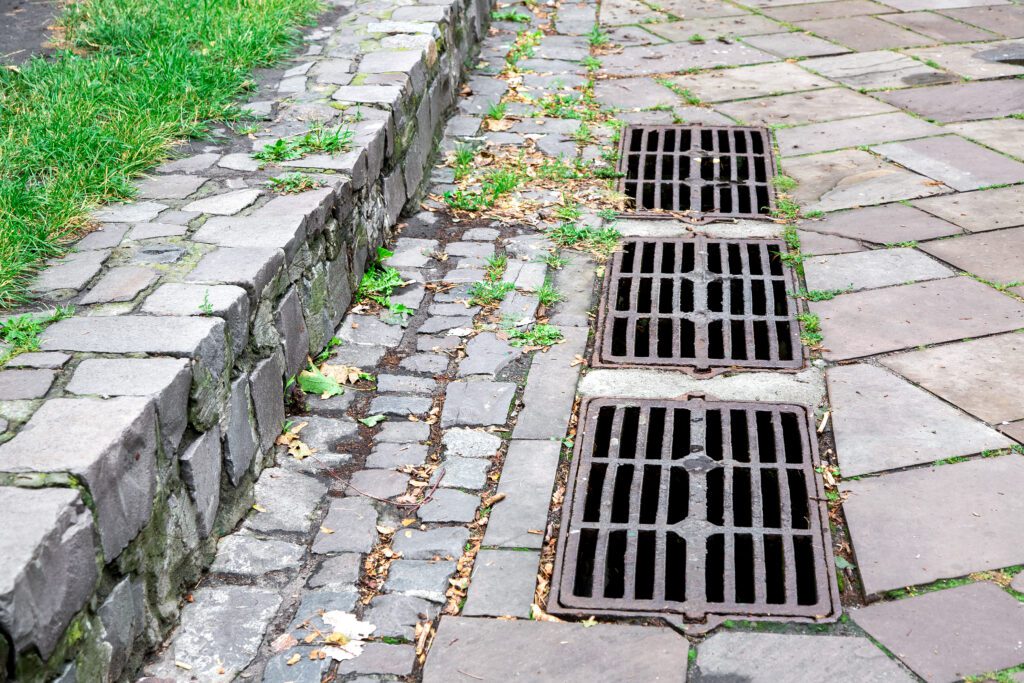
Homeowners sometimes use “French drain” to describe several different products. A surface catch basin captures water running across the lawn. A solid downspout extension carries concentrated roof runoff away without allowing it to enter the surrounding soil. A French drain generally intercepts water in the ground. These devices can work together, but they are not interchangeable.
French drain installation cost by length
For early budgeting, multiply your planned footage by the national range that matches your project type. This is a starting point, not a contractor quote: mobilization, design, pipes and fittings, disposal, outlet work, and landscape repairs can add costs that simple per-foot calculations miss.
| Approximate length | Shallow yard drain at $10–$35/ft | Interior basement drain at $40–$85/ft |
|---|---|---|
| 25 feet | $250–$875 | $1,000–$2,125 |
| 50 feet | $500–$1,750 | $2,000–$4,250 |
| 75 feet | $750–$2,625 | $3,000–$6,375 |
| 100 feet | $1,000–$3,500 | $4,000–$8,500 |
| 150 feet | $1,500–$5,250 | $6,000–$12,750 |
| 200 feet | $2,000–$7,000 | $8,000–$17,000 |
Why can a contractor quote be higher than the table? Length-based national examples frequently describe the drain itself. A customized residential drainage project may also involve connecting roof leaders, managing sump-pump discharge, reshaping low areas, restoring sod, or choosing an engineered outlet. To compare two bids fairly, make sure they include the same complete scope.
A 50-foot drain: when a smaller project is practical
A 50-foot trench may help one wet portion of a lawn if water is moving toward an accessible low point. It can be relatively straightforward when the route is free of major roots, fences, existing hardscaping, and utility conflicts. But if the nearest lawful outlet is another 60 feet away, the drain is not truly a 50-foot project. Ask where collected water will end up after it leaves the perforated section.
A 100-foot drain: the common price comparison trap
A 100-foot shallow yard drain starts at about $1,000–$3,500 using the national rate alone. That is not a prediction for an Illinois backyard that also needs regrading and sod. When reviewing a contractor’s proposal, separate the perforated collection pipe from the solid outlet pipe and any connections. Doing so reveals what the quote covers and makes change orders less surprising.
Long perimeter systems: why access matters more than footage
Drains around foundations may require working near utility entrances, patios, HVAC equipment, decks, and landscaped beds. Excavating to footing depth can demand shoring or other professional safety measures. A long perimeter drain is a construction project with drainage components, rather than a narrow lawn trench. This is why its per-foot rate is materially higher than a shallow yard drain.
French drain cost in Naperville and Chicagoland: real examples from Ware Landscaping
National pricing guides provide perspective, but homeowners looking for a contractor should also study what a local drainage provider actually includes. At the time this article was reviewed, Ware Landscaping’s Naperville drainage service page displayed these example packages:
| Ware Landscaping published package | Advertised starting/example price | What the published description includes |
|---|---|---|
| Basic | $3,995 | 30-foot French drain; connection to one downspout and the sump pump |
| Standard | $9,995 | 90-foot French drain; two downspouts and sump pump; regrading and sod for a 90′ × 15′ area |
| Premium | $14,995 | 150-foot French drain; four downspouts and sump pump; regrading and sod for a 150′ × 20′ area |
These figures are published examples, not guaranteed current offers or universally applicable per-foot rates. The service page says estimates vary by individual property. Each package combines different services. Dividing $9,995 by 90 feet, for example, would wrongly assign every dollar of grading and sod work to the French drain pipe. If you want a comparable bid, ask the contractor to show the major work categories.
Properties around Naperville, Wheaton, Downers Grove, Hinsdale, Aurora, and nearby communities may have clay-rich soils that drain slowly, limited elevation changes, and seasonal freezing. The combination matters. A backyard can look fairly level while sitting below adjoining properties, and a simple gravity drain may not have a practical discharge route. In that case, the solution could involve a collection well and pump rather than a longer trench.
Local takeaway: Don’t assume a $10-per-foot web result is what a professionally installed, restored, multi-component drainage system should cost near Chicago. Confirm precisely what is included and get a site-specific drainage plan.
Seven factors that change the final French drain price
1. Excavation depth and the water problem being solved
The deeper the trench, the more soil must be removed and handled. Shallow lawn saturation and groundwater alongside a foundation are different conditions. Digging below existing landscaping or hardscaping increases labor and reinstatement work. A qualified contractor should explain why the proposed pipe elevation reaches the water source rather than choosing depth from a generic chart.
2. Soil, roots, rock, and hidden site conditions
Heavy clay can make excavation and spoil removal more difficult, while root systems or buried debris may force a route change. Saturated soils can make trenches unstable and slow equipment. In yards with no vehicle access, much of the work may need to be completed by hand or with compact machinery. Ask how unanticipated underground conditions are handled in the contract.
3. Pipe, aggregate, fabric, and fitting specifications
Pipe quality matters, but there isn’t one product that is universally best for every installation. Contractors may choose rigid or flexible pipe based on slope, load, access, and long-term maintenance requirements. Washed aggregate, suitable geotextile, fittings, cleanouts, and basin details affect both cost and performance. A bid that says only “install drain pipe” tells you too little.
4. The discharge destination
This is often the overlooked cost driver. Water needs an appropriate outlet, whether that means a permitted storm connection, an approved surface discharge, a dry well in suitable soil, or a pump-assisted system. Rules vary by municipality and property. Do not assume a contractor may route your water onto a neighbor’s land or into a public sewer without authorization. The outlet can be farther away than the soggy section that prompted the project.
5. Downspout and sump-pump connections
Roof runoff and sump discharge can deliver large volumes of water quickly. They may need separate solid pipe to move water without dumping it into soil beside the foundation. If multiple downspouts and a sump outlet are part of the plan, the project may require additional trenching, fittings, catch basins, and maintenance access. Ask how the design handles peak flows and whether the system mixes or separates these water sources.
6. Yard grading and lawn restoration
Sometimes the yard needs reshaping so surface water can reach collection points instead of forming puddles elsewhere. Restoration may include topsoil, seed, sod, retaining-edge repairs, or replacing planting beds. These costs improve the appearance and function of the entire property, but they shouldn’t be confused with the pipe cost alone.
7. Permits, utility locating, and seasonal access
Before excavating in Illinois, a utility locate request is essential. JULIE/811 handles utility-location notifications outside Chicago; inside Chicago city limits, use the city’s 811 Chicago/DIGGER process. Private irrigation, landscape lighting, and other owner-installed lines may require a separate private locate. Check local permit and stormwater-discharge requirements before work begins. Illinois guidance.
Watch: what professional French drain installation looks like
It is easier to understand installation pricing after seeing the work on a real property. This video is embedded on Ware Landscaping’s French Drain Installation for Yard Drainage page and demonstrates drainage work before the trench is finished.
Video: French Drain Installation Explained | Bruce’s Drainage Project (Before Gravel). Sourced from an existing Ware Landscaping webpage. Confirm channel ownership and playback before publishing.

DIY French drain cost vs. professional installation
DIY can be reasonable when the water issue is minor, the route is simple, utilities are identified, and a lawful, lower outlet exists. You still need a way to dig safely, transport or dispose of soil, buy stone and fabric, establish slope, and restore the disturbed ground. Some homeowners underestimate just how much gravel and excavated soil a modest trench involves.
A DIY budget should include pipe, fittings, washed stone, geotextile, delivery charges, trenching or rental equipment, a level or laser, disposal, and lawn repair. An excavator or trencher also takes time to operate safely. If the project involves significant depth, an unstable excavation, a basement, retaining wall foundations, or work near essential utilities, a professional assessment is the safer choice.
Professional pricing buys more than labor. A competent drainage contractor identifies the source of the problem, plans elevations, selects a discharge method, completes utility coordination, restores the site, and explains what maintenance will be needed. These elements matter most when mistakes could direct more water toward the house.
Example: why a DIY estimate can be misleading
Imagine a homeowner prices 60 feet of perforated pipe and gravel and decides the project is inexpensive. After digging, there is nowhere for the water to go. The property is effectively flat and the discharge location is uphill. Buying more gravel will not fix the elevation problem. The job may need a professionally designed collection basin or pump-assisted discharge, and the unfinished lawn may need to be dug up again. Planning the outlet first could have prevented the wasted effort.
French drain, trench drain, catch basin, or dry well: which is worth paying for?
The best drainage choice depends on whether the problem involves water moving across a surface, water traveling through soil, or water collecting in a low point.
| System | Often best for | Important price consideration |
|---|---|---|
| French drain | Saturated soil and subsurface water | Trench length, depth, aggregate, outlet |
| Trench/channel drain | Fast-moving surface water across a driveway or paved area | Grate, pavement cutting, load rating |
| Catch basin with solid pipe | Concentrated surface runoff in a low spot | Basin count, debris maintenance, outlet |
| Dry well | Temporary storage and infiltration where soil and regulations permit | Percolation, storage volume, access for maintenance |
| Regrading/swale | Redirecting surface runoff by shaping the landscape | Soil movement, sod and bed restoration |
| Pump-assisted drainage | Low areas without gravity drainage | Basin, electrical work, pump selection, discharge, maintenance |
A trench drain is usually a visible surface channel with a grate; a French drain is generally a buried subsurface collection system. Installing either one without enough outlet capacity can simply relocate the puddle. The U.S. EPA also describes options such as rain gardens, swales, and infiltration practices that help manage runoff where site conditions allow. EPA stormwater guidance.
For water problems close to a foundation, be careful with shortcuts. A French drain can be one piece of a moisture-management strategy, but basement leaks may also involve exterior waterproofing, cracks, gutter failures, poor grading, or an interior drain-and-sump system. A drainage contractor and, when appropriate, a foundation or waterproofing specialist can help identify the actual source.
Interior vs. exterior French drain costs
Exterior yard drains often cost less because crews can work in accessible soil without removing interior concrete. They are a common option where ponding or soil saturation can be intercepted and water can travel to an appropriate outlet. A deeper exterior footing drain is different: foundation-adjacent excavation can be invasive and requires additional expertise.
Interior basement drains require opening a channel along the basement floor perimeter, installing a drainage pathway, and often connecting to a sump basin and pump. They can manage water after it reaches the foundation area, rather than correcting every exterior source of runoff. Interior work may also require attention to dust, flooring, finished walls, utilities, and restoration.
Crawl-space drains may involve less concrete removal but can be difficult to access and work in. Low clearance and moisture remediation can change the budget. Across all three locations, water disposal is the key question: where does the system send the collected water, and how is that discharge maintained safely?
How to estimate your French drain budget without guessing
Use this simple planning method before contacting contractors.
Step 1: Identify where water enters and where it can leave. Walk the property after a rain when safe to do so. Record puddle locations, nearby downspouts, obvious slopes, wet basement walls, and the lowest points. Photos taken during a storm can be useful to a contractor.
Step 2: Measure the proposed route, not just the wet patch. The pipe may have to extend to a legal discharge point well beyond the waterlogged area. Note gates, trees, fences, hardscaping, and equipment access.
Step 3: Apply a suitable reference range. For an ordinary yard drain, use $10–$35 per foot to establish a national baseline. For deeper footing or interior basement work, use the higher relevant ranges. Treat this as a preliminary number, not a final estimate.
Step 4: List separate site-work items. Ask whether the contractor must add catch basins, connect downspouts, reroute the sump line, install a pump, regrade the lawn, or replace sod. Write those items down independently.
Step 5: Request an itemized site quote. A good estimate explains the approach, intended outlet, major materials, surface restoration, scheduling assumptions, and exclusions. Ask who handles locates and permits, whether any protection or guarantee applies, and what happens if the proposed outlet cannot be used.
Worked example: a 100-foot yard project
Assume a project needs 100 feet of shallow French drain. The national reference is $1,000–$3,500 for that drain length. Now assume the homeowner also needs two downspout extensions, a collection basin, a longer solid outlet route, lawn regrading, and new sod. Those are additional scope items, so the total quote may be much higher. Because each home differs, assigning a universal package price to those extras would be misleading.
A better comparison is to request two proposals that solve the same identified problem. One may use a trench plus catch basins; another may propose grading and an outlet line. Compare expected performance, maintenance, risks, and complete installed costs—not only the price per foot.
What an effective French drain quote should include
When evaluating French drain installation contractors, look for a proposal that answers the following questions in plain language:
- Problem diagnosis: Is the objective to capture shallow groundwater, surface runoff, roof discharge, or seepage beside the foundation?
- System layout: How long and how deep is the system, and where will it be installed?
- Materials: What pipe type and diameter, stone, filter fabric, collection basins, fittings, and cleanouts will be used?
- Discharge plan: Exactly where is the water going, and is that outlet permitted and likely to work during storms?
- Other work: Are downspouts, sump-pump lines, grading, erosion controls, and sod restoration included?
- Site protection: What happens around utilities, trees, fences, driveways, and existing irrigation?
- Aftercare: What inspection, maintenance, warranty or guarantee terms are included, and what is excluded?
Ask for photos or examples of comparable local projects—not just generic pictures of a trench. If the contractor promises the drainage will be “maintenance free forever,” ask how they expect basins, outlet screens, root intrusion, and sediment to be handled. Long-lived drainage systems still need sensible oversight.
How to maintain a French drain after installation
French drains are often low-maintenance, but they are not always no-maintenance. Surface leaves can block basin grates. Soil or sediment can accumulate at inlets and outlets. Grass clippings or mulch may cover pop-up emitters. Tree roots may intrude into some systems, and frost or debris can interfere with discharge.
Inspect accessible basins and outlets seasonally, especially before periods of heavy rain and after major storms. Keep visible grates and outlet points clear. If the original problem returns, ask the installer to check the discharge route, slope, and pipe condition instead of simply adding more stone on top. For buried systems, professional troubleshooting may involve checking access points and evaluating whether the outlet has changed.
Homeowners in northern Illinois should pay special attention to winter conditions. Snowmelt can occur while soil is still frozen, and a buried discharge line can back up if its outlet becomes obstructed or freezes. An appropriate design considers the full path and local seasonal conditions, not merely the fact that the pipe is underground.
Watch: why yard drainage planning matters
This second video is embedded on Ware Landscaping’s South Barrington yard-drainage page. It provides additional context on yard drainage challenges; check the video title and channel ownership before publishing it in the final post.
How to avoid paying for the wrong drainage system
A costly mistake is assuming that every puddle requires a French drain. If the yard slopes toward the home, regrading may be necessary regardless of the drain chosen. If a downspout empties beside the foundation, moving that water away in a solid conveyance line may solve more than adding a perforated pipe nearby. If the property lies below every possible outlet, gravity alone may not be enough.
The most useful first question to a drainage company is not “How much per foot?” It is “Where is the water coming from, and where will your proposed system send it?” Once the contractor can explain that route, their cost estimate becomes much easier to evaluate.
Do not rush into excavation beside a basement wall or retaining wall without competent advice. Disturbing soil in these areas can affect structural support, waterproofing, or buried services. Confirm site safety and local approvals before work begins.
Frequently asked questions about French drain costs
How much does it cost to install a French drain in 2026?
A shallow yard drain commonly costs around $10–$35 per linear foot installed nationally. Deep exterior foundation systems often run $30–$90 per foot, and interior basement perimeter drains around $40–$85 per foot. Your final price depends on scope and site conditions, so request an on-site quote.
How much does a 100-foot French drain cost?
At a basic yard-drain reference range of $10–$35 per foot, 100 feet comes to about $1,000–$3,500. If a project includes catch basins, more outlet pipe, a sump connection, grading, and lawn restoration, the total may be substantially higher.
Is a French drain worth the money?
It can be when it solves a well-diagnosed drainage problem and sends water to an appropriate outlet. The value is less clear if the problem is caused by a blocked gutter, incorrect yard grading, or a discharge point that cannot accept additional water. A diagnosis should come before the drain design.
Does a French drain increase home value?
A functional drainage solution may make a property easier to use and maintain and reduce concerns about persistent moisture. However, there is no universal percentage of resale value added by a French drain. Documentation, permits where required, and proof that the system works may be more persuasive than unsupported return-on-investment claims.
What is the cheapest way to install a French drain?
For a simple accessible lawn with a workable outlet, a carefully planned shallow trench may have a lower total cost than a deep foundation system. DIY can reduce paid labor, but you still need suitable materials, utility locates, safe excavation, and restoration. The lowest initial bid is not necessarily the lowest lifetime cost if it fails.
Can you install a French drain without destroying the lawn?
Some disruption is generally necessary because a trench must be excavated. Contractors can often limit disturbance by choosing a practical route, using suitable equipment, and restoring soil and sod when the project is finished. Ask for lawn restoration in writing rather than assuming it is included.
How long does a French drain last?
Service life varies with pipe and material selection, soil conditions, installation quality, sediment load, root intrusion, outlet function, and maintenance. No realistic lifespan can be promised for every yard. Ask the installer about inspection access and what their warranty or guarantee covers.
Does a French drain need a sump pump?
Not necessarily. A French drain can use gravity if the layout has a feasible slope to an approved lower outlet. When the property is a low point without gravity discharge, a designer may recommend a collection basin and pump-assisted system. Such systems have additional installation and maintenance costs.
What’s the difference between a French drain and a trench drain?
A French drain generally collects moisture through gravel and perforated pipe beneath the surface. A trench or channel drain collects runoff through a visible surface channel and grate, often beside a driveway or paved area. They address different flow paths and have different installed costs.
Should I install an exterior or interior basement drain?
That depends on why the basement gets wet. Exterior grading, downspout management, and foundation drainage can prevent or intercept water outside. Interior drainage can collect seepage that reaches the basement perimeter and route it to a pump. Serious or persistent leaks deserve an assessment rather than a choice based only on price.
Get a French drain estimate that solves the real problem
The best French drain isn’t the cheapest trench. It’s the system that captures the right water, carries it reliably, and has a safe place to discharge. National cost calculators are useful for planning, but a real estimate should account for the entire property, including soil, existing landscaping, roof runoff, sump discharge, and maintenance access.
Ware Landscaping works with homeowners in Naperville and neighboring Chicagoland communities on yard drainage, French drains, downspout routing, regrading, and pump-assisted solutions. If your backyard stays soggy after every rain or water collects near your foundation, start with a site assessment and ask for a clearly scoped proposal.
Request a French drain and yard drainage estimate from Ware Landscaping or call 630-885-6370. Ask about current availability, quote inclusions, and the terms of the company’s drainage guarantee.
Sources and further reading
- HomeGuide: French Drain Installation Cost (updated February 2026) — national cost ranges for yard, foundation, and interior systems.
- Angi: How Much Does a French Drain Cost? (2026) — additional context on cost variables and restoration.
- Ware Landscaping: Naperville Landscape Drainage Services — published local service descriptions, package examples, and drainage approach.
- U.S. EPA: Urbanization and Stormwater Runoff — background on runoff and alternatives.
- State of Illinois: Utilities and JULIE / Chicago DIGGER — excavation safety and utility-locate guidance.