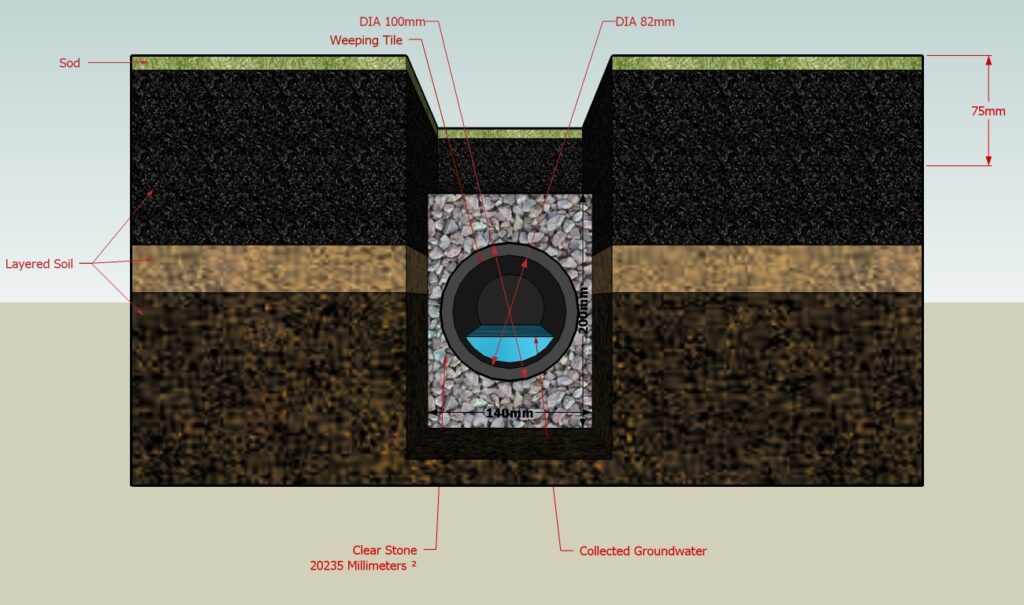

A French drain that worked properly for years can gradually lose its ability to move water. Sediment builds up, pipes shift, roots enter the system, outlets become blocked, and sections of the trench can settle.
Those problems are easy to overlook during dry weather.
Then winter arrives.
Once the ground freezes, drainage problems become harder to repair and can create bigger problems around your lawn, walkways, foundation, or basement. That is why fall is one of the best times to look for signs that French drain repair may be necessary.
If water is pooling where it used to disappear, your yard remains soggy long after rain, or your basement moisture problem has returned, your drainage system may already be telling you something is wrong.
Here are the warning signs to look for before freezing temperatures arrive.
Why French Drain Repair Matters Before Winter
Winter changes the way water moves around your property.
Once the upper layers of soil freeze, rain and melting snow cannot soak into the ground as efficiently. Water may instead travel across the surface or collect around low areas and foundations.
A properly functioning drainage system helps move that water away.
A clogged, crushed, or poorly sloped drain may not.
During a winter thaw or spring snowmelt, that can lead to standing water, icy walkways, saturated soil, increased pressure against foundation walls, and basement moisture.
Repairs also become more difficult after the ground freezes.
If your drain is already showing symptoms in the fall, dealing with them before winter is usually easier than waiting until the next major thaw.
1. Water Is Pooling Directly Over the Drain
One of the clearest signs that French drain repair may be needed is standing water directly above or alongside the drainage trench.
The drain was installed to prevent that problem.
When water begins collecting in the same area again, common causes include:
- A clogged perforated pipe
- Sediment filling the gravel
- A crushed section of pipe
- Root intrusion
- A blocked outlet
- Settling that has reduced the slope
Pay particular attention to water that remains for 24 to 48 hours after an ordinary storm.
A brief puddle during a heavy downpour is one thing. Water that continues sitting long after surrounding areas have begun drying suggests the system is not moving water efficiently.
2. Your Yard Stays Soggy After Light Rain
Not every drainage problem creates a visible puddle.
Sometimes the first warning sign is a lawn that remains soft, spongy, or saturated after relatively light rain.
Walk along the path of the drain after a storm.
If the soil above it feels much wetter than nearby areas, water may be moving too slowly through the gravel or pipe.
The problem could be minor sediment buildup, but persistent saturation may indicate that the gravel bed has become clogged or that part of the system has lost its slope.
3. There Is Little or No Water Coming From the Outlet
A simple way to evaluate drainage performance is to inspect the outlet while it is raining.
When the surrounding soil is saturated, you should generally see water discharging from the system.
If your yard is wet but the outlet remains dry, there may be a blockage somewhere between the collection area and the discharge point.
First, check the obvious.
Leaves, mulch, grass, soil, and landscaping debris can cover a daylight outlet or pop-up emitter.
If clearing the outlet does not restore flow, the line may require flushing, inspection, or repair.
4. The Problem the Drain Was Supposed to Fix Has Returned
Think back to why the drainage system was installed.
Maybe you had:
- Standing water in the lawn
- Wet planting beds
- Water near the foundation
- Basement dampness
- Erosion around patios or walkways
If those same issues are gradually returning, the system may no longer be functioning as intended.
A drain does not necessarily need full replacement just because symptoms return.
In many cases, cleaning or localized French drain repair can restore performance.
The important thing is not to ignore the change.
5. You See Depressions or Small Sinkholes
The ground above a properly installed drain should generally remain stable.
Sunken areas, narrow depressions, erosion channels, or small sinkholes may indicate movement below the surface.
Possible causes include:
- Gravel washing away
- Pipe collapse
- Soil entering the trench
- Settlement
- Underground voids
These areas can worsen during repeated freeze-thaw cycles.
They can also create trip hazards that become difficult to see once the ground is covered by snow.
6. Mulch or Soil Keeps Washing Away
Repeated erosion near the drain line can mean water is moving across the surface rather than being captured underground.
You may notice mulch collecting at the bottom of a slope, soil disappearing from landscape beds, or small channels forming after storms.
This can happen when the gravel bed becomes packed with fine sediment or when changes to the landscape alter the direction of runoff.
Correcting the drainage problem can help protect both the drain itself and the surrounding landscaping.
7. You Notice Musty Odors Near the Drain
A persistent musty, swampy, or sour smell may indicate water is sitting in the system rather than moving through it.
Organic material trapped in wet gravel or soil can begin to decompose.
Odor alone does not prove the pipe has failed, but odor combined with standing water or soggy ground deserves attention.
8. Basement Dampness Has Returned
Drainage problems near a foundation should be taken seriously.
When groundwater is not moved away properly, moisture can build around foundation walls.
Homeowners may notice:
- Damp concrete or masonry
- Water stains
- Musty basement odors
- Mold or mildew
- White mineral deposits
- Puddles after storms
White powdery deposits on basement walls, often called efflorescence, can be a sign that moisture is moving through the masonry.
Snowmelt can make these problems worse.
When frozen soil cannot absorb water, melting snow may collect around the foundation and increase hydrostatic pressure against basement walls.
9. Your Sump Pump Is Running More Often
If your drainage system feeds into a sump pump, changes in pump activity can provide useful clues.
A pump that suddenly runs far more frequently than it did in previous seasons may mean more groundwater is reaching the foundation.
Extremely wet weather can also cause additional pump activity, so this is not always a sign of drain failure.
But when frequent cycling occurs together with wet soil or basement moisture, the drainage system should be inspected.
10. You Are Seeing New Foundation Cracks
Foundation cracks have many possible causes, and drainage is only one of them.
However, new or widening cracks combined with poor exterior drainage deserve attention.
Water collecting around the foundation increases pressure on foundation walls and surrounding soils.
Addressing a drainage problem early can be much less expensive than dealing with major structural or basement water damage later.
Foundation repairs can run into thousands or tens of thousands of dollars, while water and mold damage in a finished basement can also become costly.
11. The Same Areas Become Icy Every Winter
If the same section of lawn, driveway edge, or walkway repeatedly develops ice, excess water may be collecting there.
A drainage problem that seems minor in October may become a slippery safety hazard once temperatures fall below freezing.
Repeated icing can also damage turf and nearby landscaping.
If you know where those winter ice patches usually appear, inspect those areas before the first freeze.
Can a French Drain Freeze?
It can, particularly when water remains trapped inside the pipe.
Many yard drains are only around 18 to 24 inches deep, while frost depths in colder parts of the country can reach 36 to 48 inches or more.
That does not necessarily mean every drain needs to be installed below the frost line.
Proper slope is often more important.
A drainage pipe that maintains positive fall allows water to empty after each storm.
A common guideline is approximately 1 inch of fall for every 8 to 10 feet of drainage run.
Flat or sagging sections can hold residual water, increasing the risk of freezing during cold weather.
How Long Does a French Drain Last?
A quality drainage system can often last 20 to 40 years, with around 30 years commonly used as a general planning figure.
Some well-installed rigid PVC systems may last even longer.
Lower-quality installations may fail much sooner.
Systems using inexpensive corrugated pipe, poor-quality fabric, improper gravel, or inadequate slope may begin experiencing problems within 5 to 15 years.
Clay soil can also shorten the effective life of a poorly protected system because fine particles can migrate into the gravel and eventually clog the pipe.
If your system is more than 10 to 15 years old and drainage performance has changed, a fall inspection can be worthwhile.
Try a Simple Flow Test
Homeowners can perform a basic test before calling for professional French drain repair.
Run a garden hose into the high end of the drainage system.
Then monitor the outlet.
You should typically see a steady flow of water reach the discharge point fairly quickly, depending on the length of the system.
If the outlet only produces a weak trickle, nothing appears, or water backs up near the starting point, the system may contain a blockage or flattened section.
A camera inspection can help locate problems that cannot be identified from the surface.
Does the Drain Need Cleaning, Repair, or Replacement?
Not every failing system needs to be replaced.
Cleaning May Be Enough When:
- The outlet is blocked
- Sediment accumulation is light
- The pipe is still structurally sound
- The system is relatively young
- Water flow improves after flushing
Typical drain cleaning may cost roughly $200 to $600.
More aggressive hydro-jetting can commonly range from around $350 to $800, while difficult jobs may cost more.
Repair May Make Sense When:
- One pipe section has collapsed
- Roots are affecting a limited area
- One section has settled
- The outlet is damaged
- The problem is isolated
Professional French drain repairs often range from roughly $1,000 to $5,000, depending on depth, access, excavation, and restoration needs.
Replacement May Be Better When:
- Sediment has filled most of the trench
- Fabric has failed throughout the system
- Corrugated pipe has collapsed in several places
- The system was undersized from the beginning
- Iron ochre repeatedly clogs the entire run
- A 20- to 30-year-old system has multiple failures
Replacing an old system may cost more initially, but repeatedly excavating and repairing different sections can eventually cost more.
Pre-Winter Drainage Checklist
Before freezing weather arrives:
- Inspect and clear the outlet.
- Flush the line and confirm water reaches the discharge point.
- Look for standing water along the trench.
- Check for depressions or settled areas.
- Remove mulch, leaves, and soil blocking drainage points.
- Protect unusually exposed shallow sections where necessary.
- Schedule professional inspection if symptoms continue.
Periodic maintenance can significantly extend the service life of a drainage system.
Many homeowners should inspect outlets once or twice each year and consider flushing the line every two to five years, depending on soil conditions and system design.
Schedule French Drain Repair Before the Ground Freezes
Drainage problems rarely improve on their own.
A blocked outlet in September may turn into an icy yard in December. A slow drain in October may contribute to basement moisture when snow begins melting.
Addressing the warning signs early gives you more options.
Our Recent French Drainage Outing
Sometimes the solution is simply cleaning the system.
Other situations require localized repair or replacement of an older drain.
If you are seeing standing water, soggy soil, erosion, basement moisture, poor outlet flow, or other warning signs, Ware Landscaping can help evaluate the problem and determine the appropriate next step.
Contact Ware Landscaping to schedule French drain repair or a drainage inspection before winter conditions make the problem more difficult to address.