
When it comes to maintaining a beautiful, functional outdoor space, water management is everything. Without a proper drainage system, even the most stunning landscape can suffer from flooding, erosion, and foundation damage. That’s why professional drainage solutions are at the heart of what we do at Ware Landscaping. Whether your yard floods every spring or water pools near your patio after heavy rain, choosing the right system can save you time, money, and stress in the long run.
But not every drainage problem requires the same solution. A dry well can manage roof runoff where the soil allows infiltration, a swale can redirect surface water across a sloped yard, and a channel drain can collect runoff from a driveway. French drains address subsurface water, while regrading corrects the land contours that allow water to collect in the first place.
Below, we’ll explain how these five options work, show you how to choose between them, and walk through real-world property scenarios to help you identify the right starting point.
Start Here: Which Backyard Drainage System Do You Need?
Before choosing a drainage system, identify where the water comes from, how it moves, and where it can safely go. Use the following decision guide to narrow down your options.
- Water pools in a low spot after rain, but the surrounding ground drains reasonably well: Consider a dry well if the soil can absorb the water and there is sufficient separation from foundations and groundwater.
- Rainwater flows across your lawn from a higher part of the property: Consider a swale to redirect and slow surface runoff.
- Water collects along your driveway, patio, or another paved surface: A channel drain may intercept the runoff before it reaches a garage, doorway, or lower area.
- Your lawn stays soggy for days, or groundwater collects near the foundation: A French drain may help collect and redirect subsurface water.
- Water flows toward your house because the yard slopes the wrong way: Regrading may correct the underlying problem by directing surface water away from the building.
- You have several of these problems at once: A combination of systems may be needed, designed around the property’s grading, soil conditions, and available discharge points.
The destination matters as much as the collection method. A drain that captures water but has nowhere suitable to discharge it may simply move the problem elsewhere. Before excavation or construction, check underground utilities, local drainage requirements, and any applicable restrictions on discharging runoff onto neighbouring properties or into stormwater systems.
1. Dry Wells: A Compact Solution for Roof Runoff and Localized Pooling
Dry wells are underground structures that collect runoff and allow it to infiltrate into surrounding soil. They are often connected to roof downspouts or other suitable runoff collection systems, making them useful when water from a concentrated source repeatedly collects in one area.
A typical system directs water into a chamber or gravel-filled structure below ground. The water is temporarily stored and gradually disperses into the surrounding soil.
When a Dry Well Makes Sense
Consider a dry well when:
- A downspout releases large amounts of water into one part of the yard.
- A small area repeatedly collects runoff from a roof or paved surface.
- The soil can absorb water at a suitable rate.
- There is enough space to install the system safely away from foundations and other sensitive areas.
Field example: A homeowner notices that the lawn below a rear downspout becomes muddy after every heavy storm. The rest of the yard drains reasonably well, but water discharged directly from the roof overwhelms the small area beneath the downspout. A properly sized dry well may help collect and disperse that runoff instead of allowing it to spread across the lawn.
When a Dry Well Is Not the Best Choice
A dry well is less suitable where the groundwater level is high, the soil drains very slowly, or the system would be too close to a foundation. Clay-heavy soil can limit infiltration, and a dry well may overflow if it receives more water than the surrounding ground can absorb.
The system also needs a way to manage excess water during unusually heavy rainfall. It should not be installed simply because water collects in a low spot; first determine whether the problem is excessive runoff, poor grading, or groundwater.
Installation costs vary with the chamber type, excavation, soil conditions, and required connections. The original estimates of 1,165–4,420 should be treated as broad budgeting figures rather than a guaranteed price.
A soggy lawn is a sign of a failing landscape. Don’t settle for a swampy yard that breeds mosquitoes and kills your grass—get a professional drainage system engineered to keep your property bone-dry.Stop Your Backyard From Becoming a Retention Pond
2. Swales and Bioswales: Redirect Surface Water Across the Yard
A swale is a shallow, gently sloped channel that guides surface runoff toward a suitable outlet or allows some water to infiltrate into the soil. It can be grass-lined, gravel-lined, or planted with vegetation suited to the site.
A bioswale uses vegetation and appropriate soil or engineered media to help slow runoff, retain sediment, and support infiltration where conditions allow.
Because swales remain visible, they can be integrated into the landscape rather than hidden underground. They are particularly useful when water flows across a broad area of lawn instead of emerging from one specific point.
When a Swale Makes Sense
Consider a swale when:
- Runoff travels from the back or side of the property toward the house.
- A sloped lawn channels water through the same area during storms.
- There is enough space to create a shallow drainage route.
- You want to combine drainage with planting or landscape design.
Field example: A property sits below a neighbouring slope, and rainwater regularly crosses the lawn before pooling near the patio. A shallow, carefully graded swale can intercept the flow and guide it toward an appropriate outlet before it reaches the patio.
When a Swale May Fall Short
Swales require adequate space and a carefully planned grade. A flat yard may not provide enough fall for gravity drainage, while dense clay soil can limit infiltration. A swale also cannot solve every groundwater problem simply by moving surface runoff.
Its performance depends on the channel shape, slope, vegetation, soil, expected runoff volume, and maintenance. Heavy flows can erode an inadequately designed channel, while debris and sediment may obstruct the intended route.
For yards where water collects after rainfall, professional yard drainage solutions can help determine whether a swale is appropriate or whether another system is needed.
3. Channel Drains: Collect Runoff From Driveways and Patios
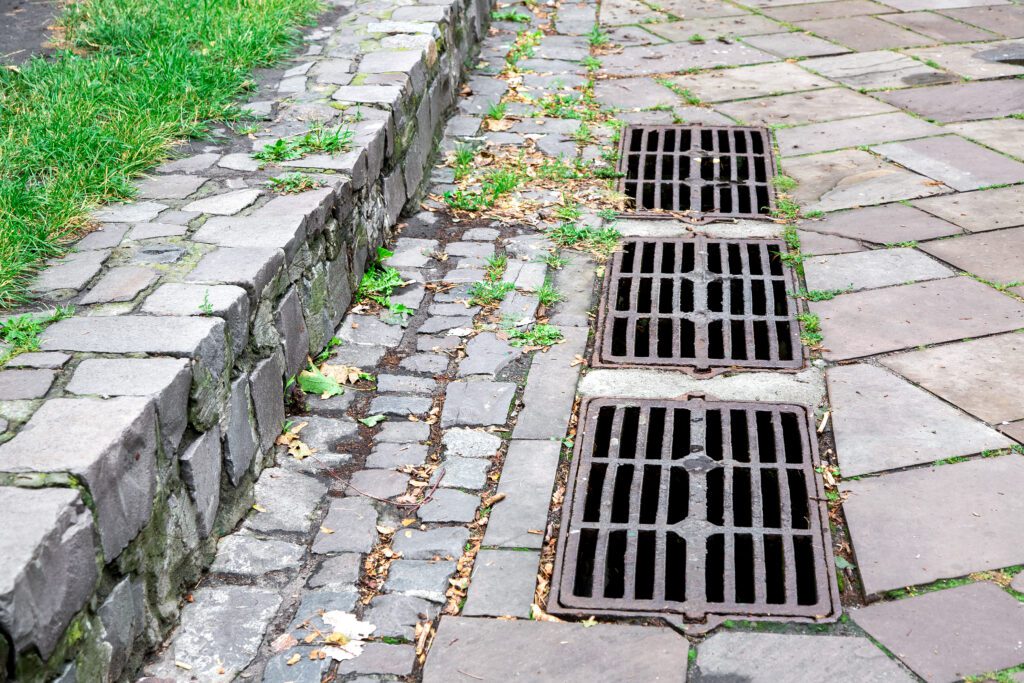
Channel drains, also called trench drains, are narrow surface-level channels covered with grates. They collect water flowing across hard surfaces and direct it through a connected outlet.
They are commonly installed across driveway entrances, along garage thresholds, beside patios, and around other paved areas where water needs to be intercepted.
When a Channel Drain Makes Sense
Consider a channel drain when:
- Rainwater flows down a driveway toward a garage.
- Water pools along the edge of a patio.
- Runoff crosses a paved walkway or entertainment area.
- The surface has limited options for redirecting water through grading alone.
Field example: A sloping driveway directs stormwater toward a garage door. Instead of allowing water to reach the threshold, a correctly positioned channel drain collects the runoff and conveys it to an approved discharge point.
When a Channel Drain Is Not Enough
A channel drain collects surface water; it does not automatically resolve groundwater beneath the lawn or foundation. Its capacity also depends on the channel dimensions, grate openings, surface grading, and outlet.
Leaves, sediment, and other debris can reduce flow, so the grate and channel require periodic cleaning. In areas exposed to vehicles, the channel and grate must also be rated for the expected loads.
Explore yard drainage services for hardscape and landscape areas to determine whether a channel drain or a broader drainage design is appropriate for your property.
4. French Drains: Manage Persistent Subsurface Water
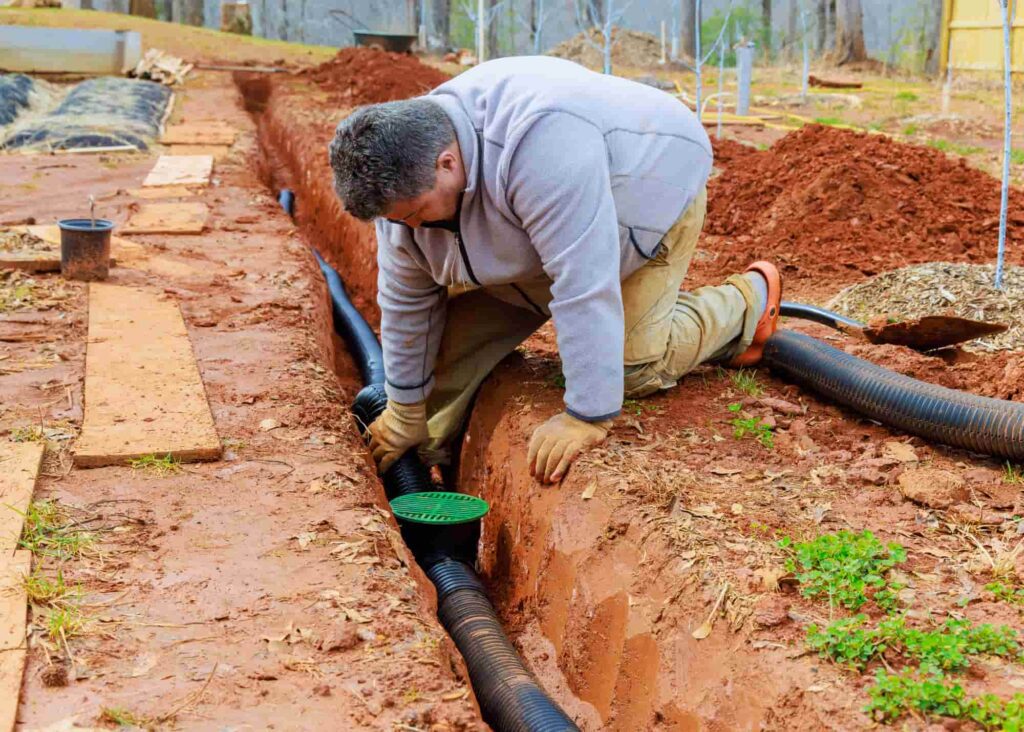
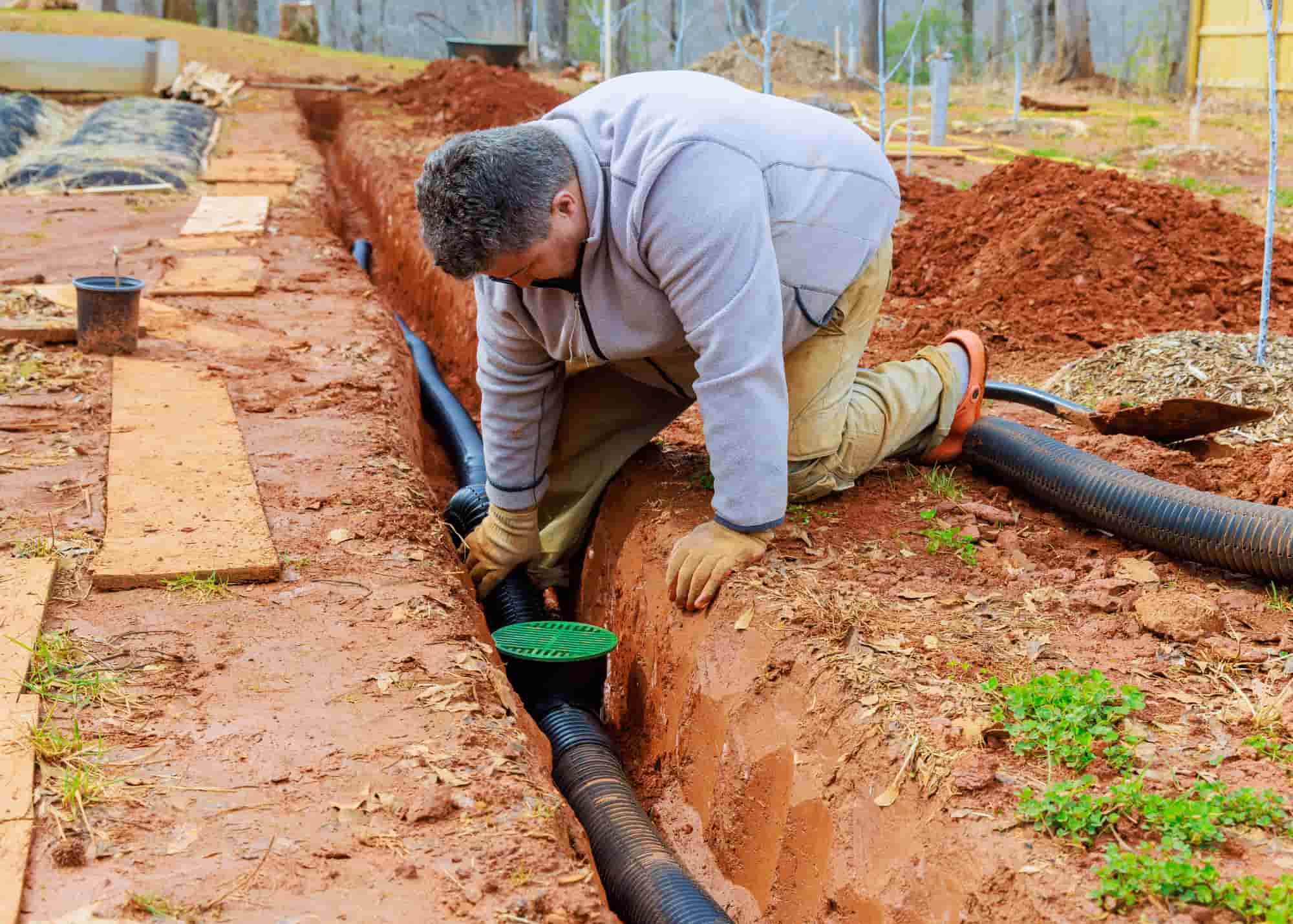
French drains are underground systems designed to collect and redirect water moving through saturated soil. They typically consist of a perforated pipe surrounded by drainage aggregate within a trench, with filter fabric used where appropriate to limit soil intrusion.
As groundwater enters the gravel-filled trench, it can flow into the perforated pipe and travel toward a suitable outlet.
When a French Drain Makes Sense
Consider a French drain when:
- The lawn remains saturated long after rainfall has ended.
- Groundwater collects near a foundation.
- A low area stays soggy even when there is little visible surface runoff.
- Soil conditions cause persistent subsurface moisture problems.
Field example: A homeowner notices that a section of lawn remains soft and spongy for several days after a storm, even after surface water has disappeared. An assessment finds that subsurface water is accumulating in the area. A properly designed French drain may help collect and redirect that water.
When a French Drain May Not Solve the Problem
A French drain is not a substitute for correcting every surface drainage issue. If runoff flows directly toward the house because the lawn slopes toward the foundation, regrading may be necessary as well.
The system also needs an appropriate discharge route and sufficient fall, unless a suitable pumped design is used. Poor installation, sediment accumulation, root intrusion, or a blocked outlet can reduce performance over time.
Learn more about French drain installation and how it redirects groundwater before deciding whether this system matches your drainage problem.
5. Regrading: Correct the Slope That Causes Water to Collect
Sometimes the most effective drainage solution is not a drain at all. Regrading changes the contours of the land so surface water flows away from vulnerable areas and toward an appropriate drainage route.
Depending on the site, the work may involve adding or removing soil, reshaping low spots, correcting the slope near a building, or combining grading with a swale or another collection system.
When Regrading Makes Sense
Consider regrading when:
- The ground slopes toward the house.
- Water collects in depressions created by settlement or uneven landscaping.
- Runoff repeatedly follows an unintended route across the lawn.
- A patio or walkway sits lower than the surrounding ground and receives runoff.
Field example: A homeowner finds that rainwater consistently collects beside the foundation because the soil has settled and now slopes toward the house. Correcting the grade may redirect surface runoff before it reaches the foundation, reducing the need for an additional drainage system.
When Regrading Alone May Not Be Enough
Regrading cannot always solve high groundwater, poorly draining soil, or runoff entering from a neighbouring property. A site may also have limited space or elevation differences that prevent water from being redirected by gravity.
Any grading changes should preserve appropriate drainage patterns and avoid sending water toward neighbouring homes. The work may require additional drainage components if there is no suitable surface route for the runoff.
Comparing the Five Backyard Drainage Options
| System | Best for | Space and slope | Soil considerations | Winter performance | Indicative cost |
| Dry well | Concentrated roof runoff and localized pooling | Underground installation; needs suitable space and separation from structures | Requires soil that can absorb water; poor infiltration can cause overflow | Underground storage can function, but frozen soil may slow infiltration | Original estimate: 1,165–4,420 |
| Swale or bioswale | Surface runoff moving across the lawn | Needs visible space and a suitable grade toward an outlet | Infiltration depends on soil; clay may limit absorption | Snow and ice can obstruct the channel, and frozen ground limits infiltration | Conventional swales: about 5–15 per linear foot; planted systems may cost more |
| Channel drain | Runoff across driveways, patios, and other hard surfaces | Requires a channel at the collection point and a suitable outlet | Less dependent on lawn infiltration, but the outlet must work | Grates and outlets can become blocked by snow, ice, and debris | Original estimate: 1,000–4,000 |
| French drain | Persistent subsurface moisture and saturated soil | Underground trench; needs a suitable gravity outlet or engineered pump system | Can collect groundwater in clay, but water still needs somewhere to discharge | Underground components are protected from direct snowfall, but frozen outlets or saturated soil can affect performance | Varies substantially with length, depth, and outlet; original estimate: 500–18,000 |
| Regrading | Water flowing toward a house or collecting in shallow depressions | Requires enough space and an achievable elevation change | Soil type affects how quickly water infiltrates, but grading controls surface flow | Can improve runoff direction during snowmelt, although frozen ground may restrict infiltration | Site-specific; depends on excavation, soil movement, and restoration |
These figures are planning estimates, not quotes, and the ranges are not directly comparable across projects. Installation costs depend on the site’s size, access, soil, materials, labour, drainage outlet, and any additional work required. Winter performance also depends on local climate, maintenance, and the system’s design.
A soggy lawn is a sign of a failing landscape. Don’t settle for a swampy yard that breeds mosquitoes and kills your grass—get a professional drainage system engineered to keep your property bone-dry.Stop Your Backyard From Becoming a Retention Pond
How to Choose the Right System for Your Yard
Use these field scenarios to narrow down your options before arranging a professional assessment.
Scenario 1: Water Collects Beneath a Downspout
Likely starting point: A dry well, if the soil and groundwater conditions are suitable.
First, check whether the downspout is discharging too close to the house or concentrating runoff in one location. Extending the downspout to a safe discharge area may solve the issue without a larger installation. A dry well is worth considering when a properly designed infiltration system is suitable for the site.
Scenario 2: Water Flows Across the Lawn From Higher Ground
Likely starting point: A swale or regrading.
If runoff travels across the yard in a predictable direction, a swale can provide a defined route for the water. If the problem is caused by an incorrect slope near the house, regrading may address the underlying cause.
Scenario 3: Rainwater Collects at the Garage Entrance
Likely starting point: A channel drain, potentially combined with grading.
A channel drain can intercept runoff before it enters the garage. The driveway’s slope, the channel’s capacity, and the outlet all need to be checked to make sure the system can handle the expected flow.
Scenario 4: The Lawn Remains Soggy for Days
Likely starting point: A French drain, after assessing the cause.
Persistent saturation may indicate subsurface water, but poor soil infiltration and surface depressions can produce similar symptoms. Identify the cause before deciding on the system.
Scenario 5: Water Pools Against the Foundation
Likely starting point: Check grading first, then assess whether a drainage system is also needed.
Surface water running toward the house may be redirected through regrading or a swale. If groundwater is also contributing to the problem, a French drain or a more comprehensive foundation drainage solution may be necessary.
Scenario 6: Several Areas Flood During Heavy Rain
Likely starting point: A coordinated drainage plan.
A property may need more than one system. For example, regrading can direct surface water toward a swale, a channel drain can collect driveway runoff, and a French drain can address persistent subsurface moisture. The components should be designed together so the combined flow does not overwhelm the outlet.
A soggy lawn is a sign of a failing landscape. Don’t settle for a swampy yard that breeds mosquitoes and kills your grass—get a professional drainage system engineered to keep your property bone-dry.Stop Your Backyard From Becoming a Retention Pond
Can You Combine Backyard Drainage Systems?
Yes. Combining systems can be effective when a property has more than one source of water, but each component must be designed for its intended role.
A channel drain may collect driveway runoff while regrading directs water away from the house. A French drain may address subsurface saturation in a separate part of the yard. A dry well may manage roof runoff if soil conditions allow infiltration.
Before connecting systems, confirm that the receiving component and final outlet can handle the additional water. Directing a French drain into a dry well, for example, may not work if the well cannot absorb the combined flow. Likewise, a swale can overflow if it receives more runoff than it was designed to carry.
The goal is not to install the greatest number of drainage components. It is to solve the actual problem with the simplest reliable combination.
Why Professional Installation Matters
Backyard drainage involves more than digging a trench or moving soil. The system must account for water sources, soil conditions, slope, rainfall, nearby structures, and the location of a suitable outlet.
Poorly planned work can move water toward another part of the property, create erosion, damage underground utilities, or leave a system that overflows during heavy rainfall. Some projects may also require permits or approval for grading, drainage connections, or stormwater discharge.
At Ware Landscaping, a property-specific assessment can help identify the source of standing water and determine whether a dry well, swale, channel drain, French drain, regrading, or a combination is the best fit.
Final Thoughts
The best backyard drainage system is the one that addresses the source of the water rather than simply hiding the symptoms.
A dry well can help manage concentrated roof runoff when the soil can absorb it. A swale can redirect surface water across a suitable landscape. A channel drain can intercept runoff from paved areas. A French drain can collect subsurface water, while regrading can correct slopes that send water toward your home.
If your yard has several drainage problems, a coordinated solution may be more effective than installing one system in isolation.
Request a free drainage consultation from Ware Landscaping to discuss your property’s drainage challenges and identify the most appropriate next steps.
Our Work Speaks for Itself
See examples of landscaping and outdoor work in this project video.