
Your sump pump is running — but do you know where it’s actually sending the water?
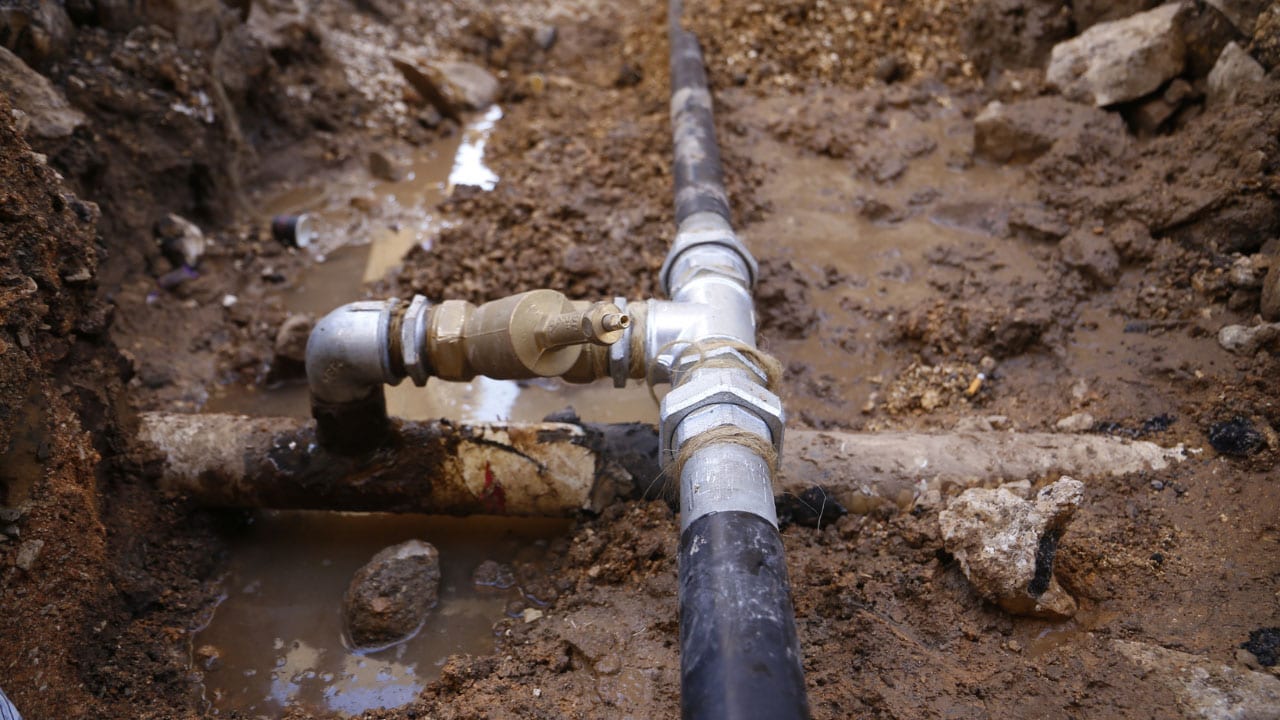
Most homeowners don’t. The discharge pipe leaves the basement, disappears into the wall, and from that point it’s a mystery. For many Chicago-area properties, that mystery ends badly: a buried pipe that was never properly extended, one terminating too close to the foundation, or one crushed under years of landscaping — quietly sending water right back toward the house it was supposed to protect.
Whether you’re troubleshooting a drainage problem, planning a project, or simply trying to understand your property’s underground systems, here’s how to find your sump pump discharge pipe and other buried drain lines.
Why You Need to Know Where Your Sump Pump Drains
Before any digging, excavation, or new construction, you need a clear picture of what’s underground. For sump pump discharge lines specifically, four problems make this urgent.
Recirculation. The discharge point must be at least 10 to 20 feet from your foundation. A line that terminates too close — or was broken, moved, or buried by mulch over the years — sends the same water your pump ejects right back into the soil and back into the pit. The pump runs constantly, burns out early, and the basement never dries.
Illegal connections. In Illinois and most municipalities, discharging into the sanitary sewer is prohibited. If you’ve moved into a home and don’t know where the line goes, verify it’s not making an illegal connection.
Stop Guessing Where Your Water Is Going
Mystery pipes and blocked discharge lines are a recipe for a flooded basement. Let our team locate, map, and repair your underground drainage before the next big storm hits.
Request a Free QuoteFreezing. Chicago-area frost lines reach approximately 40 inches deep. An improperly buried discharge line will freeze in winter, block discharge entirely, and can burn out the pump motor.
Construction damage. A patio, driveway, retaining wall, or deep-rooted planting over an unknown buried line can collapse it silently — until the basement floods.
Step 1: Start Inside — Trace the Discharge Line from the Source
The most reliable starting point is your basement. Find the sump pit and follow the discharge pipe up and out. Standard discharge pipe is 1¼ to 1½ inch diameter PVC. It should rise vertically from the pump, pass through a check valve, and then route horizontally toward the exterior wall.
Note where the pipe exits the house. Outside, it will emerge either above grade (visible along the wall) or below grade (buried). Mark that point and step outside.
Step 2: Search the Exterior for the Discharge Point
Walk the perimeter from the exit point and look for these common configurations:
Above-grade discharge: A white or gray PVC pipe visible along the foundation wall, terminating 10 to 20 feet from the house with a splash block or elbow pointing away. These are easy to spot but vulnerable to freezing and accidental damage.
Pop-up emitter: A flush-mounted plastic cap in the lawn, usually green or black, at a low point in the yard. These stay closed at rest and pop open when the pump runs. Unsure if something is your emitter? Activate the pump and watch.
Buried line to curb or storm sewer: The pipe may continue underground to the curb, a storm drain, or the property edge. Walk a straight line from the house exit toward the lowest point of the yard and look for an outlet.
Bubbler pot: On flat lots, a bubbler pot — a dome or lid flush with the yard surface — fills and overflows to release water at grade.
If you find nothing visible along the likely path, the line is buried. Move to the next step.
Step 3: DIY Methods to Find the Buried Line
The water flow test is the simplest method. Activate the pump by adding water to the pit until the float triggers, then walk the property watching for water to emerge at an emitter, curb, or low point. Nothing appearing means the pipe is blocked, broken, or terminating somewhere unexpected.
Probing the ground works when you have a reasonable idea of the path. Use a 3/8-inch metal probe rod and push gently every few inches along the suspected route. You’re looking for hollow resistance distinct from soil or rock, indicating plastic pipe below. Be careful: thin-walled corrugated pipe punctures easily under force.
Follow the soil depression. Trench soil settles differently than undisturbed ground. In wet conditions or low-raking light, a faint linear depression running from the house toward a low point often marks the pipe’s path.
Snake and metal detector. Feed a metal plumber’s snake into the discharge line from inside, then run a metal detector on the surface above the suspected route to track it underground, revealing exact path and depth.
Step 4: Finding Other Underground Drain Pipes in Your Yard
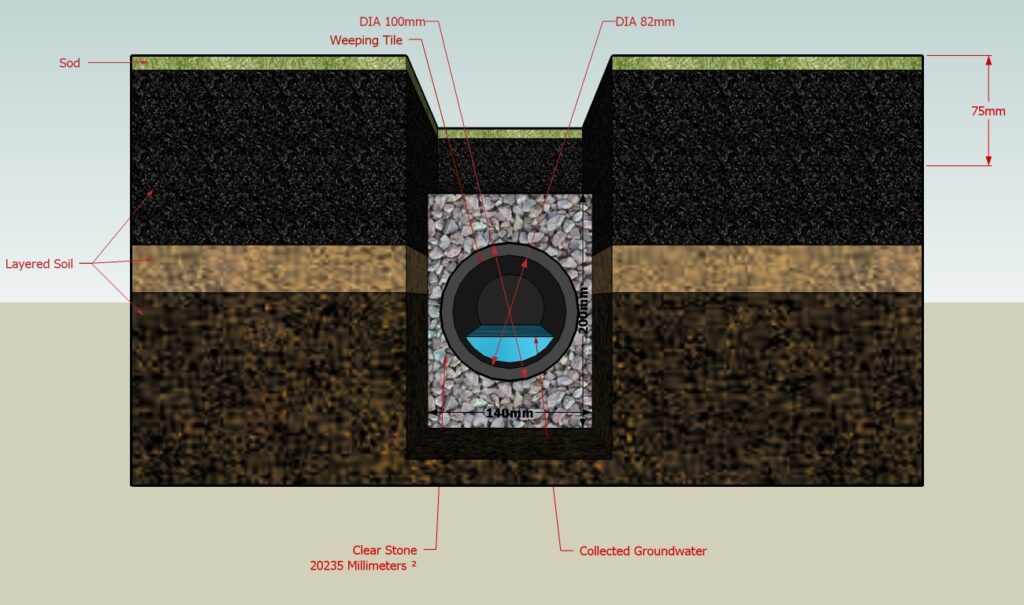
The same techniques apply to other buried private drainage: French drain outlets, downspout extensions, yard drain connections. None appear on an 811 call.
Always call 811 first. Call at least two to three business days before digging. Public utilities will be marked; private drainage won’t. Ruling them out is legally required and the essential safety first step.
Check building records. Your local building department may have as-built drawings from permitted drainage work. Not always accurate, but a useful starting reference.
Look for greener grass or soft spots. A cracked buried pipe typically creates a band of lusher grass above it or a persistently soft wet area in an otherwise dry lawn. Follow that pattern toward a likely outlet.
Step 5: When to Call a Professional
If DIY steps fail, or you suspect the pipe is broken, crushed, or blocked, professional equipment removes all guesswork.
Video camera inspection runs a waterproof camera through the pipe, showing exactly where it goes, where it ends, and any cracks, root intrusions, or collapses along the way.
Sonde locating places a small radio transmitter inside the pipe that a surface receiver tracks, giving precise location and depth without any digging.
Ground Penetrating Radar (GPR) maps all underground infrastructure in a single pass, the gold standard for non-metallic PVC pipes on complex or large properties.
Don’t Let “Out of Sight” Mean “Out of Mind”
A sump pump discharge pipe that’s broken, too short, frozen, or terminating in the wrong place isn’t just ineffective — it can actively cause the basement flooding it was designed to prevent.
Stop Guessing Where Your Water Is Going
Mystery pipes and blocked discharge lines are a recipe for a flooded basement. Let our team locate, map, and repair your underground drainage before the next big storm hits.
Request a Free QuoteAt Ware Landscaping, we locate, assess, and repair underground drainage systems across Naperville, Hinsdale, Wheaton, Barrington, and the greater Chicago suburbs. We also properly bury and extend sump pump discharge lines to ensure they terminate far enough from the foundation, are protected from freezing, and connect to a system that moves water off your property for good. Every installation is backed by our 10-year drainage guarantee.
Schedule your free consultation today.
Call 630-885-6370 or visit warelandscaping.com