
Photo by Argelis Disla on Unsplash (Unsplash License)
Almost everything you know about yards from the Chicago suburbs flips on a Myrtle Beach golf lot. The soil is sand instead of clay, the lawn is warm-season grass instead of bluegrass, and an HOA architectural committee decides much of what goes in the ground.
The good news is that the drainage instincts you built fighting Illinois clay still matter. They just point in a different direction.
How are Myrtle Beach soil and climate different from the Chicago suburbs?
Myrtle Beach has sandy coastal soil and sits in USDA hardiness zone 8b, while many Naperville lawns grow on compacted clay in zone 5b. In practice, Grand Strand yards drain fast, dry out fast, and rarely freeze hard, so the plants, turf, and watering habits that work around Chicago mostly don’t transfer to a coastal golf lot.
In zone 5b, the coldest night of a typical year falls between 10 and 15 below zero. Zone 8b bottoms out between 15 and 20 above.

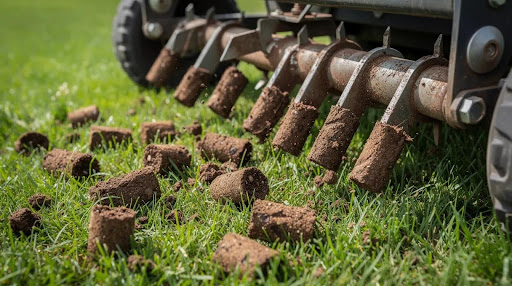
Around Chicago, the usual problem is water that won’t leave. University of Illinois Extension notes that many lawns grow on post-construction soils that are high in clay, compacted, and poorly drained, which is why core aeration, topdressing, and drainage work fill so many of our spring calendars.
On the Grand Strand, the problem runs the other way. Sandy coastal soil takes water in quickly and doesn’t hold it for long.
Sand changes a few other habits:
- Amend planting holes and beds with organic matter so roots have something that holds moisture and nutrients.
- Mulch every bed. Bare sand dries out, heats up, and washes around.
- Don’t assume fast drainage everywhere. Flat lots, low corners, and spots near ponds can still hold water after a hard summer storm, so walk the lot after heavy rain before you design anything.
What grass grows on a Myrtle Beach golf lot instead of Kentucky bluegrass?
Warm-season grasses replace Kentucky bluegrass on a Myrtle Beach golf lot. Bermudagrass and zoysiagrass are the realistic choices for most lots, St. Augustinegrass suits part-shade spots, and centipedegrass works only on sheltered inland lots. Clemson Cooperative Extension recommends tall fescue only for South Carolina’s Piedmont and mountains and limits Kentucky bluegrass to altitudes above about 1,000 feet.
Illinois Extension calls Kentucky bluegrass by far the most popular home-lawn species in the state, and turf-type tall fescue has become a common choice too.
Here’s how the realistic coastal options compare with the grass you know, using Clemson’s lawn grass ratings:
| Grass | Salt tolerance | Shade tolerance | Wear tolerance | Mowing height (in.) | Maintenance | How it fits a golf lot (our field view) |
| Bermudagrass | Good | Very poor | Excellent | ¾-1½ | High | Closest match to the fairway; needs full sun and hard bed edges |
| Zoysiagrass | Good | Excellent | Very good | ¾-2 | High | Dense, upscale look; handles part shade and ball-hunting foot traffic |
| St. Augustinegrass | Excellent | Excellent | Fair | 2½-4 | Moderate | Good for part-shade spots (still needs 4-6 hours of sun); coarse texture reads differently from the course |
| Centipedegrass | Poor | Fair | Poor | 1½-2 | Low | Fine on sheltered inland lots; weak on salt exposure and cart-path edges |
| Tall fescue (the Midwest habit) | Good | Good | Fair | 2½-3½ | Moderate | Not recommended on the coast; Clemson limits it to the Piedmont and mountains |
Notice the mowing heights. If you’re used to cutting bluegrass tall, a bermuda lawn kept around an inch will feel like a putting green by comparison.
Bermuda matches the course but invades everything. South Carolina golf courses rely on it, so it blends with the fairway. It also spreads above and below ground and is very difficult to keep out of beds, so budget for steel or stone edging from day one and keep it out from under tree canopy.
Zoysia is the patient choice. It establishes slowly from sod or plugs (plugs can take up to two growing seasons to fill in) and builds thatch when over-fertilized. In exchange, you get a dense lawn that handles part shade and traffic.
Centipede is popular, just not on most golf lots. It’s low-maintenance, but it has poor salt tolerance, won’t take heavy foot traffic, and is highly susceptible to nematodes in sandy soils. With golfers wandering through hunting for balls, it wears thin fast.
What HOA landscaping rules come with a Myrtle Beach golf lot?
Myrtle Beach golf communities typically require architectural review approval for new beds, trees, fences, lighting, irrigation, and grading. Many also limit fences on the course side, set height rules and approved plant lists, and reserve maintenance strips the club mows. Every community writes its own rules, so read them before you make an offer.
Most of that homework belongs before you buy, not after. Midwesterners shopping for golf course homes around Myrtle Beach can use a guide to Myrtle Beach golf course communities to shortlist neighborhoods before the first tour. Whether you’re weighing Grande Dunes, The Dunes Club, or Pawleys Plantation, add two questions to the usual HOA-and-amenities checklist: what will it cost to bring the yard up to the community’s standard, and what are you actually allowed to change?
“Buyers coming down from the Midwest usually have strong opinions about lawns, and that’s fine, but the HOA has opinions too,” says broker Jerry Pinkas, whose firm, Jerry Pinkas Real Estate Experts, is an independent Myrtle Beach real estate brokerage, founded in 2005, that helps buyers relocating to the Grand Strand.
“I tell them to read the architectural review guidelines before they write an offer, not after closing,” he says. “That strip of grass between the patio and the fairway looks like your backyard, but sometimes it isn’t yours to plant.”
If you’re used to a light-touch suburban HOA, a golf community will feel strict. Before planning anything, collect three documents:
- The current ARB guidelines, including any approved plant list.
- A survey showing exactly where your rear property line falls.
- Any recorded course maintenance or drainage easement.
Those pages keep you from planting a hedge on land the club owns.
How do you handle drainage and runoff next to a fairway or pond?
On a coastal golf lot, sand absorbs most ordinary rain, so the real drainage issues are surface flow during heavy storms and where that water ends up. Learn the course grading, never fill or block a swale, send downspouts toward the lawn, and keep fertilizer and turf back from pond edges.
This is where Midwest drainage experience pays off, with adjustments. On clay, we spend a lot of time getting water to soak in or move away through French drains and dry wells.
- Learn the course grading. Fairways are shaped to shed water, and some of it may be designed to cross or skirt your lot. Find the swales before you design beds.
- Never fill or block a swale between your lot and the course. It likely drains more than your yard, and changing it needs approval.
- Grade beds away from the foundation and send downspouts toward the lawn or an approved drainage path, not onto the fairway or straight into a pond.
- Protect sandy slopes. Loose sand erodes quickly under concentrated flow, so use mulch, groundcovers, or stone where water moves.
Pond lots need the most restraint. Clemson Extension notes that turf makes a poor shoreline plant because it has shallow roots and doesn’t tolerate wet soil well. Instead:
- Keep a fertilizer- and pesticide-free buffer along the water.
- Plant natives such as pickerelweed and soft rush at the edge.
- Keep vegetation 10 to 15 feet away from inlet pipes and outfalls.
- Ask the HOA first; community ponds are often part of the stormwater system.
How should you water a sandy golf course lot?
Water a sandy Myrtle Beach lawn early in the morning and apply about half an inch at a time, compared with about an inch on heavy soil, according to Clemson Extension. Smaller, well-timed cycles suit sand, which takes water in quickly but doesn’t hold it, and morning watering lets blades dry in coastal humidity.
Let the lawn tell you when it needs more: footprints that linger, a bluish-gray cast, or wilted, folded blades.
To learn what your system actually puts down, set five to ten straight-sided cans in a zone, run it for 15 minutes, and measure. If the course’s sprinklers already reach your back strip, adjust your schedule instead of double-watering.
How do you balance privacy, golf ball protection, and the course view?
Plant in layers rather than walls. Keep the course edge low with dwarf yaupon holly or ‘Don’s Dwarf’ wax myrtle, put taller screening such as common wax myrtle on the side property lines, and place dense salt-tolerant evergreens between the fairway landing zone and your windows. The view is why you bought the lot.
- Course edge: Keep it low. Dwarf yaupon holly, ‘Don’s Dwarf’ wax myrtle (3-5 feet tall and wide), and saw palmetto soften the line without blocking sight lines.
- Side property lines: This is where height belongs. Common wax myrtle tolerates sand, drought, and salt spray and makes a fine informal screen. It can grow 5 feet in a single season and reach 15 to 20 feet, which works between neighbors and is wrong for the back edge.
- Framing trees: A live oak or southern red cedar placed off to one side frames the view instead of covering it.
Salt filters every choice. Clemson splits coastal plants into high salt tolerance (they take direct salt spray) and moderate tolerance (they need shelter).
Yaupon holly, live oak, southern red cedar, saw palmetto, pittosporum, and wax myrtle are in the high group. Inkberry, beautyberry, and muhly grass are moderate, so tuck them behind tougher plants and space shrubs so humid air moves through them.
Then read the hole, not the house. Stand on the tee, see where drives land, and note which side of the fairway your lot sits on.
“Buyers walk the backyard on a quiet Saturday afternoon and fall in love with the view,” Pinkas says. “I ask them to come back on a weekday morning and watch where the balls actually land. A few dimples in the siding or a cracked lanai screen will tell you more than any listing photo.”
Landscaping won’t stop every ball, but it changes the odds:
- Put dense evergreen clusters between the landing zone and your glass. Layered yaupon and wax myrtle catch shots headed for windows.
- Position seating behind plantings, not out in the open toward the fairway.
- Give golfers a path. A defined mulch or stepping-stone strip at the course edge keeps ball hunters out of your beds.
- Skip fragile features on the exposed side, like glass-top tables and ceramic pots.
Key takeaways
- Read the ARB guidelines, survey, and easements before you make an offer.
- Leave bluegrass and fescue in Illinois; bermuda and zoysia are the realistic golf-lot choices.
- Sandy soil means smaller, early-morning waterings of about half an inch, plus mulch and organic matter in beds.
- Respect the course’s drainage swales and keep fertilizer away from pond edges.
- Keep course-edge plantings low, put height on the side lines, and shield glass with salt-tolerant evergreens.
The bottom line
Landscaping a golf course home in Myrtle Beach rewards Midwest buyers who are willing to drop a few habits. Sandy soil drains fast and holds little water, so irrigation runs shorter and more often. Warm-season grasses replace bluegrass and fescue, and the HOA’s architectural review board has the final say on most of what goes in the ground.
The skills that carry over are the ones built on Illinois clay: reading where water goes after a storm and grading so it moves away from the house. Next to a fairway or pond, that same attention protects the foundation and keeps the HOA satisfied.
Before closing on a lot, read the community’s landscaping guidelines, walk the property after a heavy rain and watch where golf balls land on a busy morning. Those three checks answer most of the questions a listing photo cannot.