
If your lawn looks rough every April patchy, thatchy, maybe a little swampy near the downspouts you’re not doing anything wrong. You’re just following the wrong calendar. Most spring lawn care advice online is written for national audiences, which is often weeks off for Chicagoland’s cool-season grass, clay-heavy soil, and unpredictable Midwest spring weather.
Why Chicagoland Lawns Need a Different Schedule
Most lawns in Naperville, Wheaton, Hinsdale, Barrington, and the greater Chicago suburbs are planted with cool-season grasses like Kentucky bluegrass, tall fescue, perennial ryegrass, or a blend of the three. These grow vigorously in spring and fall, when air temperatures sit in the 55–75°F range, but slow down or stress out in summer heat. That means spring is one of only two windows per year spring and fall when your lawn is biologically primed to recover, thicken, and outcompete weeds.
Our heavy clay soil adds a second wrinkle: it compacts easily and drains poorly, which makes aeration and drainage correction more important here than in looser, sandier soils elsewhere.
The Soil Test You’re Skipping (and Shouldn’t)
Before touching a fertilizer bag, the most useful thing you can do is a soil test — it tells you your actual pH and nutrient levels instead of guessing. Most turfgrass thrives in a pH range of 6.0–7.0; outside that window, grass struggles to absorb nutrients no matter how much fertilizer you apply. Chicagoland clay soil trends slightly alkaline to neutral, but it varies block to block depending on past construction and drainage history. A simple test through your county extension office or a basic home kit tells you whether you need lime, sulfur, or nothing at all.
Early Spring (Late March–Early April): Cleanup and Setup
This window starts as soon as snow fully melts and the ground firms up enough to walk on without leaving footprints.
Rake and de-thatch. Winter leaves behind matted grass, snow mold, and debris that block sunlight and airflow. A thorough rake-out not aggressive dethatching, which can stress a lawn still waking up clears the way for new growth. Save heavy dethatching for a genuine thatch problem (more than half an inch).
Sharpen the mower blades. A dull blade tears grass instead of cutting it, leaving ragged edges that brown out and invite disease. Do this before the first cut, every year.
Don't Waste Your Spring Guessing on Lawn Care
Spring is the most critical window to set your lawn up for summer success. From precision core aeration to perfectly timed weed barriers, get a professional-grade spring kickoff service that guarantees a thick, vibrant, weed-free lawn all year long.
Get a Free QuoteFirst mow. Mow when the grass reaches 3–4 inches, not by calendar date. Follow the 1/3 rule: never remove more than one-third of the blade height in a single pass. For Chicagoland’s cool-season blends, mow high about 2.5 to 3.5 inches to encourage deeper roots and naturally shade out crabgrass.
Pre-emergent herbicide. Crabgrass and goosegrass germinate once soil temperature hits roughly 50–55°F for several consecutive days, usually mid-April here, though it can shift a week or two either way depending on the year. Many extension offices use a simpler visual cue if you don’t have a soil thermometer handy: forsythia bushes blooming is a reliable natural signal that soil has crossed that threshold. Apply pre-emergent before that point. If you’re planning to overseed thin patches this spring, skip pre-emergent there it blocks grass seed from germinating right along with the weeds.
Aeration, if needed. Chicagoland’s clay soil compacts heavily under foot traffic and freeze-thaw cycles, making core aeration one of the highest-value spring tasks here. Aerate once the lawn is actively growing mid-to-late spring and pair it with overseeding or fertilizer right after, since the holes let nutrients and seed reach the root zone directly.
Mid-Spring (April–May): Growth and Weed Control
This is when cool-season lawns hit their stride, and tasks shift from cleanup to active feeding and weed management.
Fertilizing. Apply as growth ramps up typically mid-April through early May here — using a slow-release nitrogen product at roughly 0.5 to 1 lb of nitrogen per 1,000 square feet. Don’t rush this; fertilizing too early, while the lawn is still shaking off dormancy, wastes product and can encourage weak, shallow growth along with early weed pressure. Fall fertilizing matters more for long-term lawn health than spring so if you only have budget for one heavy feeding, spring can be the lighter of the two.
Weed control. Once broadleaf weeds like dandelions and clover are visible and actively growing but before temperatures climb past 85°F spot-treat with a post-emergent herbicide rather than blanket-spraying the whole yard.
Overseeding and patching. Late April through early June, once soil is consistently above 50°F, is a reasonable window to overseed thin or bare patches. It’s not as ideal as fall overseeding, but it’s a useful stopgap. Keeping newly seeded areas consistently moist, letting them dry out even once during germination can set the patch back weeks.
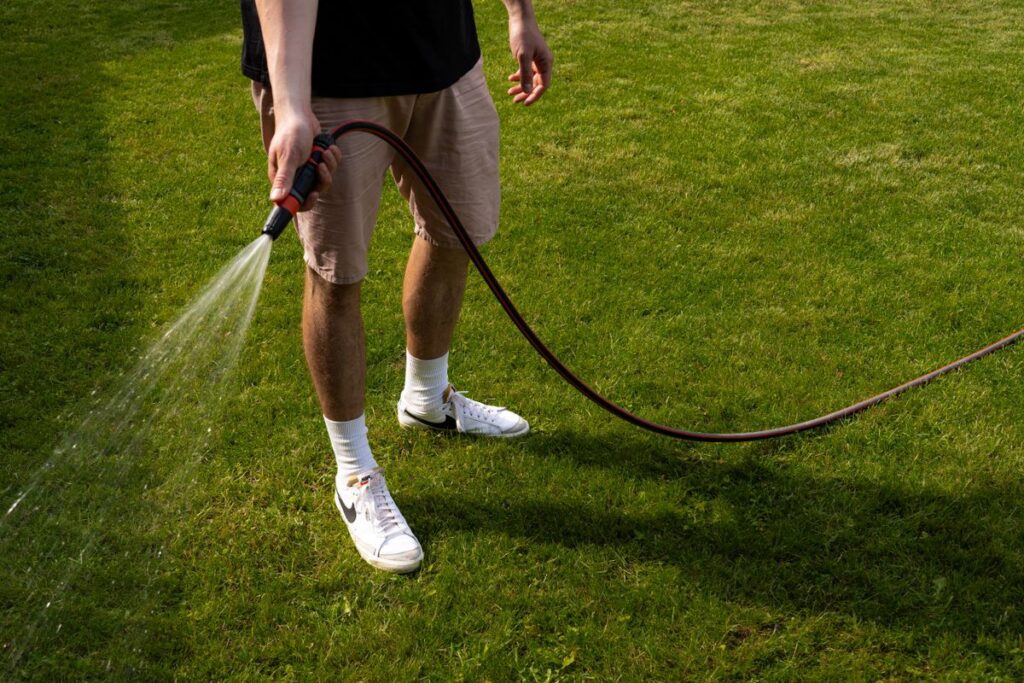
Mowing and watering. As growth accelerates, mowing frequency increases — often from every 10 days to weekly. Continue the 1/3 rule, and leave short clippings on the lawn to return nitrogen to the soil for free. Water only as needed to hit roughly 1 inch per week total, applied deeply and infrequently in the early morning rather than frequent light sprinkles, which encourage shallow roots.
Late Spring (May–Early June): Transition Watch
By late spring, the heavy lifting is behind you and the work shifts to monitoring:
- A second, lighter fertilizer application can go down roughly 6–8 weeks after the first, if growth and color suggest it’s needed.
- Watch for early signs of grubs or sod webworms, which become active as soil warms.
- Gradually raise mowing height as early-summer heat builds taller grass shades its own roots and handles heat stress better.
The Mistake Most Homeowners Make
The most common spring lawn care error in this region isn’t a missed task, it’s bad timing on a task done correctly. Fertilizing before the lawn is actively growing, applying pre-emergent after crabgrass has already germinated, or mowing too short too early all stress a lawn just coming out of dormancy. Soil temperature, not the calendar, should drive almost every decision in this guide.
When Drainage Complicates the Schedule
One issue specific to Chicagoland that doesn’t show up in national lawn care guides: heavy clay soil and flat terrain mean many yards hold standing water well into spring, delaying everything above. If sections of your lawn stay soggy long after the rest has dried out, no amount of fertilizer or pre-emergent timing will fix the underlying problem the water needs somewhere to go. A proper French drain or yard regrading addresses the cause instead of working around the symptoms every spring.
Get a Professional Assessment
A soil test and a calendar will get most lawns most of the way there. But if your lawn has compaction, drainage problems, or thin patches that return every year despite doing everything right, that usually points to a structural issue with the yard not a timing mistake.
Don't Waste Your Spring Guessing on Lawn Care
Spring is the most critical window to set your lawn up for summer success. From precision core aeration to perfectly timed weed barriers, get a professional-grade spring kickoff service that guarantees a thick, vibrant, weed-free lawn all year long.
Get a Free QuoteWare Landscaping has spent over two decades working with the specific soil, climate, and drainage challenges of Chicagoland yards. If you’d like a professional assessment heading into the growing season, request a free quote and we’ll walk you through exactly what your lawn needs this year.