
Walk any neighborhood the morning after a hard rain and you can spot the trouble fast. There’s a dark waterline where the driveway meets the garage, a puddle that sits at the bottom of the slab for two days, a strip of mud where the lawn used to be next to the concrete. Concrete driveway drainage problems rarely announce themselves with a flood. They show up as small, repeating signs that most homeowners learn to ignore until the basement gets wet.
The driveway is usually the largest hard surface on a residential lot. A standard two-car drive runs around 600 square feet, and a one-inch rain drops roughly 370 gallons of water onto a slab that size. None of it soaks in. All of it has to go somewhere, and if the slab was poured at the wrong pitch, “somewhere” is your foundation.
Why a Slab Sends Water the Wrong Direction
Concrete is poured to a slope on purpose. The slope is what moves water off the surface and toward the street or a drain instead of letting it pond. When that pitch is too flat, reversed, or settled over time, the driveway turns into a shallow ramp pointed at the house.
Building code is specific about this. The International Residential Code requires that hard surfaces like concrete and asphalt within 10 feet of a foundation slope at least 2 percent away from the building, and that the surrounding grade drop at least 6 inches over the first 10 feet. The home-inspection association InterNACHI documents these grading and drainage standards in plain language for inspectors and contractors. Two percent doesn’t sound like much. It works out to about a quarter inch of fall per foot, which is the difference between a dry garage and a recurring puddle.
Older driveways drift out of spec for a few reasons. Clay-heavy soil swells and shrinks with moisture and heaves slabs up at the seams. Poor base prep lets one section settle while the rest holds. Tree roots lift panels from below. Once a slab tilts back toward the house, no amount of sealing or patching fixes the direction the water travels.
The Quick Test You Can Do Yourself
Wait for the next steady rain and go outside with an umbrella. Watch where the water moves on the driveway. It should run clearly toward the street or a drain channel. If you see it tracking back toward the garage or pooling along the edge nearest the house, the pitch is working against you. For a dry-day version, set a marble or a golf ball on the slab in a few spots. Where it rolls tells you which way the surface actually drains, which is not always the way you assume.
Where the Water Goes After It Leaves the Concrete
A driveway with correct pitch still creates a second problem. All that runoff has to land somewhere, and if it dumps straight onto a flower bed or a low corner of the yard, you’ve traded a slab puddle for a swamp. This is the part most people miss. Fixing the concrete and fixing the drainage are two halves of the same job.
The federal stormwater guidance from the EPA notes that hard surfaces like roofs and driveways send rain rushing into streets and yards instead of letting it soak in, which is what overwhelms low spots and erodes soil. Their overview of permeable pavement and runoff walks through why impervious surfaces concentrate water the way they do. The takeaway for a homeowner is simple: every square foot of concrete is a square foot that can’t absorb water, so the runoff has to be managed on purpose, not left to find its own path.
Common ways to handle the discharge once the slab pitch is right:
- A trench drain across the bottom of the driveway, tied into a buried pipe that carries water to the street or a storm connection.
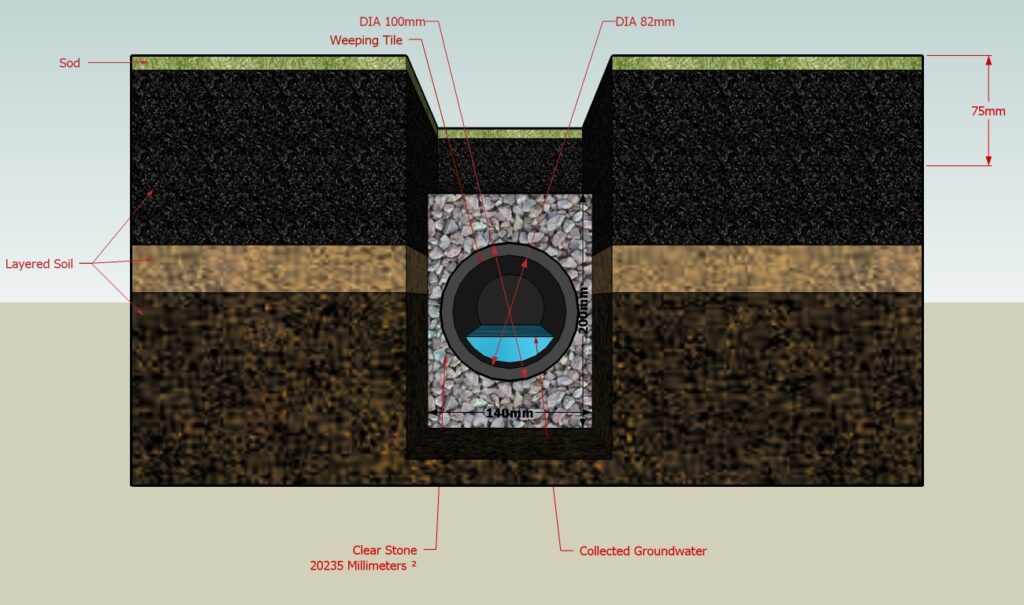
- A French drain along the edge that collects runoff and moves it to a lower point on the lot.
- Regrading the adjacent lawn so the water that leaves the concrete keeps moving away from the house.
- Swapping a failing slab section for permeable pavers that let some of the water filter down instead of sheeting off.
When It’s a Concrete Job and When It’s a Drainage Job
This is where homeowners spend money in the wrong place. They call a drainage company for what is actually a slab problem, or they repour a driveway that drained fine and skip the grading that caused the puddle. The fix depends on what’s actually broken.
If the slab itself is pitched toward the house, cracked into pieces that move independently, or settled at the apron, that’s concrete work. Mudjacking or polyurethane lifting can sometimes raise a settled section back to the right slope for far less than a full replacement. When a slab is too far gone, a contractor repours it to a correct pitch with proper base prep so it stays that way. Regional concrete crews handle this constantly; working with an experienced concrete driveway contractor means settled slabs and reversed pitch get treated as routine flatwork, and the same diagnostic logic applies no matter where you live.
If the concrete drains correctly but the water pools after it leaves the slab, that’s a drainage and grading job. Trench drains, French drains, downspout extensions, and yard regrading move the water the last stretch to a safe outlet. A lot of properties need both, done in the right order: fix the slope of the concrete first, then build the drainage to carry away what comes off it.
What Putting It Off Costs
Water against a foundation is patient. It works into hairline cracks, freezes, expands, and widens them every winter. It saturates the soil next to the basement wall and raises the hydrostatic pressure until that wall starts to bow or weep. Foundation repair runs into five figures fast, and it all traces back to a driveway that was quietly aiming a few hundred gallons at the house every time it rained. The slab fix is cheap by comparison.
Start With One Rainstorm
You don’t need a contractor to begin. You need one rainy afternoon and ten minutes of paying attention. Watch where the water goes when it comes off the driveway, mark the spots where it pools, and notice whether it’s heading toward the house or away from it. That single observation tells you whether you’re looking at a concrete problem, a grading problem, or both, and it turns a vague worry about a wet garage into a specific thing a contractor can price and fix. The water is already showing you the answer. You just have to be standing there when it does.