

When homeowners envision their dream backyard, they usually picture outdoor kitchens, ambient lighting, and lush greenery. Rarely do they picture a network of PVC pipes and gravel trenches. However, at Ware Landscaping, we know that the difference between a “dream patio” and a “foundation nightmare” often comes down to one thing: an effective patio drainage system.
With the increasingly volatile weather patterns across the U.S.—from the torrential rains of the Southeast to the intense freeze-thaw cycles of the Midwest—proper water management is no longer optional. In this guide, we will break down everything you need to know about choosing the right patio drainage system to protect your investment and your home.
What is a Patio Drainage System?
At its core, a patio drainage system is an engineered network of surface and subsurface components designed to intercept, collect, and redirect excess water away from your outdoor living space and your home’s foundation.
Unlike a simple puddle that dries up in the sun, a professional system manages “sheet flow” (water running across the surface) and groundwater (water saturating the soil). These systems typically consist of three parts:
- The Collection Point: Where water enters, such as a channel drain, catch basin, or permeable joint.
- The Conveyance: The pipes or sloped channels that move the water via gravity (requiring at least a to slope).
- The Discharge: The final destination, such as a dry well, a curb outlet, or a rain garden.
Why a Patio Drainage System is Your Home’s First Line of Defense
Ignoring standing water on your patio is a gamble you are likely to lose. When water has nowhere to go, it begins to wreak havoc on your property. Investing in a professional patio drainage system prevents:
- Foundation Failure: Water pooling near the patio can seep into the soil against your home’s foundation. This leads to hydrostatic pressure, which causes basement leaks, mold, and structural cracks. Foundation repairs in the U.S. can easily exceed , making a high-quality drainage system a high-ROI investment.
- Safety Hazards: Standing water creates slippery surfaces and attracts mosquitoes and mold.
- Material Erosion: Constant moisture causes pavers to shift, concrete to crack, and wooden decks to rot.
- The Freeze-Thaw Factor: In northern states, trapped water expands as it freezes. This “heaving” can destroy a perfectly level patio in a single winter.
Pro Tip: Look for “common signs” of failure, such as persistent puddles hours after rain, green algae growth on pavers, or visible soil erosion at the patio’s edge. If you see these, it’s time to assess your current patio drainage system.
Understanding U.S. Building Codes & Regulations
Before you dig, you must understand the rules governing any patio drainage system. Most jurisdictions in the United States follow the International Residential Code (IRC), which sets specific standards for water management:
- The Grade Rule: Your lot must be graded so surface water flows away from the foundation. The standard requirement is a minimum -inch drop in the first feet.
- The Patio Slope: Impervious surfaces like concrete or stone patios must have at least a slope (roughly inch per foot) away from the house.
- Permits: Large-scale drainage installations or changes to your property’s grading often require municipal permits, especially under NPDES/MS4 rules designed to manage city-wide stormwater runoff.
At Ware Landscaping, we always recommend checking with your local building department to ensure your project doesn’t inadvertently cause flooding for your neighbors—which can lead to legal disputes.
The Homeowner’s Toolkit: 5 Effective Patio Drainage System Types
There is no one-size-fits-all solution. Depending on your soil type (such as heavy clay vs. sandy loam) and your patio’s design, we often recommend a combination of the following:
1. Grading and Sloping (The Foundational Fix)
This is the simplest and most cost-effective method. By reshaping the land to a to slope, you allow gravity to do the work. It is essential for new constructions and should be the baseline for any hardscape project.
2. French Drains (The Subsurface Workhorse)
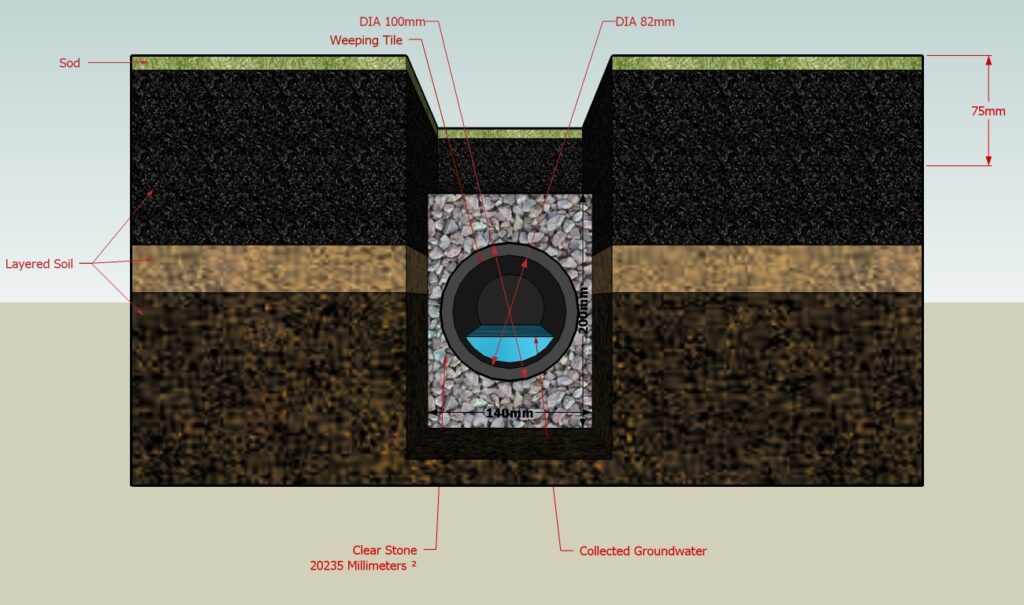
A French drain is a classic patio drainage system consisting of a perforated pipe buried in a trench filled with gravel and wrapped in geotextile fabric. It collects groundwater and redirects it to a safe discharge point. These systems are incredibly durable, often lasting to years.
3. Channel and Slot Drains (The Modern Surface Solution)
These are linear grates installed flush with the patio surface. They catch “sheet flow” water before it reaches your doorway or pool area. They are ideal for high-traffic, flat areas where traditional grading isn’t possible.
4. Dry Wells and Soakaways
If you have nowhere to “dump” the water, a dry well is an underground chamber that collects runoff and allows it to percolate slowly back into the water table. This is an eco-friendly patio drainage system perfect for smaller yards or urban environments.
5. Permeable Pavers (The Sustainable Choice)
Unlike traditional concrete, permeable pavers allow water to filter through the joints into a specialized gravel base. This dramatically reduces runoff and is increasingly incentivized by U.S. cities to prevent overwhelmed sewer systems.
2026 Cost Analysis: What to Budget for Your Patio Drainage System
Professional drainage installation is an investment in your property’s longevity. Here is a breakdown of estimated national averages for :
| System Type | Average Cost | Notes |
| French Drain | – per linear foot | Typical projects: – |
| Channel/Slot Drain | – per linear foot | Includes materials and labor |
| Dry Well | – per unit | Dependent on size and soil depth |
| Permeable Pavers | – per | Higher upfront, but prevents runoff |
| Full Yard System | – | Often includes sump pumps or basins |
Installation and Maintenance: Do It Right the First Time
While some homeowners attempt DIY grading or basic French drains, complex systems require professional precision. Here is how we approach a patio drainage system project at Ware Landscaping:
- Assessment: We perform a percolation test to see how quickly your soil absorbs water.
- The Rule of Gravity: We ensure a minimum slope for all underground piping.
- Gutter Integration: Your roof is a massive water collector. We often tie downspout extensions directly into your patio drainage system to keep that water away from the foundation.
- Long-Term Maintenance: Even the best system needs a check-up. We recommend cleaning grates and catch basins seasonally to prevent debris buildup.
Conclusion: Don’t Let Your Patio Become a Pond
A beautiful patio is only as good as the patio drainage system hidden beneath it. By adhering to U.S. building codes and choosing the right mix of surface and subsurface solutions, you can enjoy your outdoor space without worrying about the next big storm.
Are you seeing signs of water damage on your property? Referencing our Ware Landscaping Work Portfolio_5.pdf, you can see our extensive history in hardscape installation and property maintenance across various U.S. climates.
Contact Ware Landscaping today for a professional drainage assessment. Let’s keep your home dry and your patio pristine!
Keywords: Patio drainage system, French drains, Ware Landscaping, U.S. building codes, stormwater management, permeable pavers, foundation protection.