
Standing water in your yard is one of those problems that starts as a minor inconvenience and quietly becomes a serious threat to your property. Whether you are watching puddles linger for days after a storm, noticing patches of dead grass where water refuses to leave, or finding your backyard has taken on the qualities of a small swamp, the message is the same: your yard’s drainage system needs attention.
What follows covers everything you need to know. What causes yard flooding, how to identify the source of the problem, which solutions match which situations, and when it makes sense to call in a professional. You will also learn how to test your soil’s ability to absorb water, recognise common drainage symptoms, and decide whether your yard needs regrading, a drainage system, or a combination of both.
Understanding the Problem: What Causes a Yard to Flood or Hold Water?
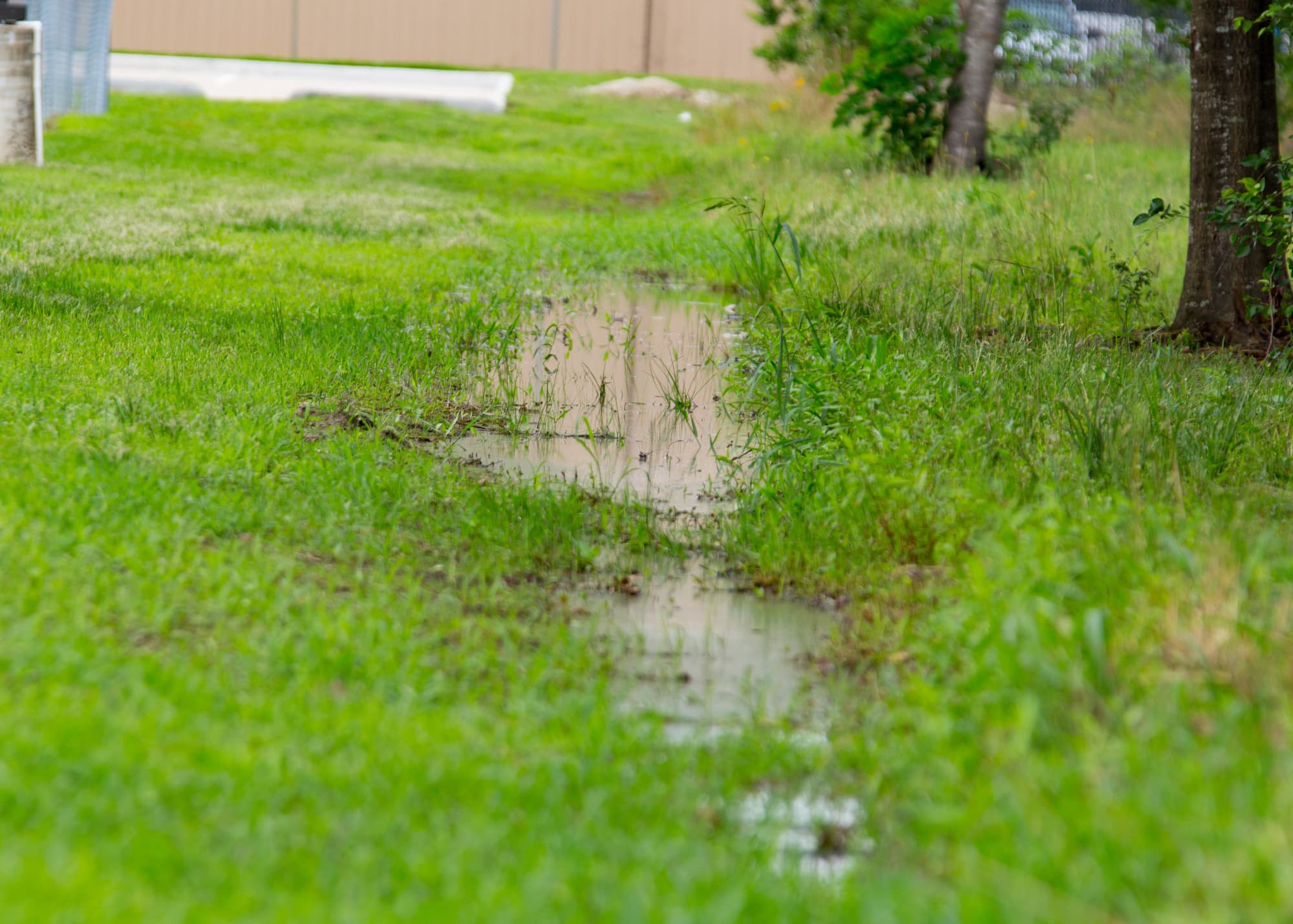
Before choosing a fix, it helps to understand what is actually happening beneath your lawn. Yard flooding and standing water are not the same issue, though they often share the same root causes. Flooding typically follows a storm and recedes with time. Standing water lingers, sometimes for days, because there is nowhere for it to go or because the ground cannot absorb it quickly enough.
The distinction matters because the solution depends on the source of the water. A low spot may need to be corrected through grading, while a lawn with compacted soil may benefit from aeration. If water continues to collect despite a reasonable slope, a drainage system may be necessary.
Stop Your Backyard From Becoming a Swamp
A soggy lawn is a sign of a failing landscape. Don’t settle for a swampy yard that breeds mosquitoes and kills your grass—get a professional drainage system engineered to keep your property bone-dry.
Get a Free QuotePoor yard grading
If your yard is flat, slopes toward your home, or has low-lying depressions, gravity will naturally pull water into those areas rather than away from your foundation. Proper grading should create a gentle slope away from your home and other structures, directing water toward an appropriate drainage area.
A commonly used grading guideline is a drop of about 6 inches over the first 10 feet away from the foundation where site conditions permit. However, the right grade depends on the property, local requirements, hardscaping, and available drainage routes. The aim is to move water away from structures without creating erosion or directing it onto neighbouring properties.
Compacted or clay-heavy soil
In the Chicago and Naperville area, dense clay soil is one of the frequent contributors to drainage problems. Compacted soil loses some of the open spaces that allow water to move through it, which means water cannot soak downward as readily. It simply sits on the surface.
Compaction can develop in areas with heavy foot traffic, construction activity, frequent vehicle movement, or repeated use of lawn equipment on wet ground. Even a lawn with a reasonable slope can remain soggy if the soil absorbs water too slowly.
Impervious surfaces
Driveways, patios, sidewalks, and other hardscaped areas prevent rainwater from being absorbed directly into the ground. Instead, that water flows across the surface and concentrates in whatever low area it finds first, often your lawn.
If water consistently collects along the edge of a patio or driveway, the problem may involve the direction of surface runoff rather than the lawn soil alone. A channel drain, grading adjustment, or other carefully designed solution may be needed to intercept the water before it spreads.
Gutter and downspout issues
Clogged gutters, damaged downspouts, and extensions that release water too close to the foundation can create a flood zone beside your home. A roof collects water over a large surface, so a single downspout can deliver a substantial volume of runoff to one small section of the yard.
Check that gutters are clear, downspouts are securely connected, and water is discharged far enough from the foundation to prevent it from flowing straight back toward the house. The appropriate distance depends on the property and local requirements; simply adding an extension will not solve the problem if it releases water into another low spot.
High water tables
In low-lying areas, the ground may already be saturated from below, leaving little room for additional rainwater to soak in. This can be particularly relevant during wet periods in northeastern Illinois.
If the lawn remains wet even after several dry days, or if several areas of the property are affected at once, the problem may involve groundwater rather than a single surface depression. In such cases, a drainage solution must account for the source of the water and where it can safely discharge.
Damaged or blocked drainage lines
If your property has an existing drainage system, such as a French drain, catch basins, or dry wells, age, debris, sediment, and root intrusion can reduce or eliminate its effectiveness over time.
A system that worked well for years may begin to fail as landscaping changes, inlets become obstructed, or the volume of runoff increases. Before installing a replacement, check whether the existing system needs cleaning, repairs, or a change in capacity.
Quick Troubleshooting Guide: What Is Your Yard Telling You?
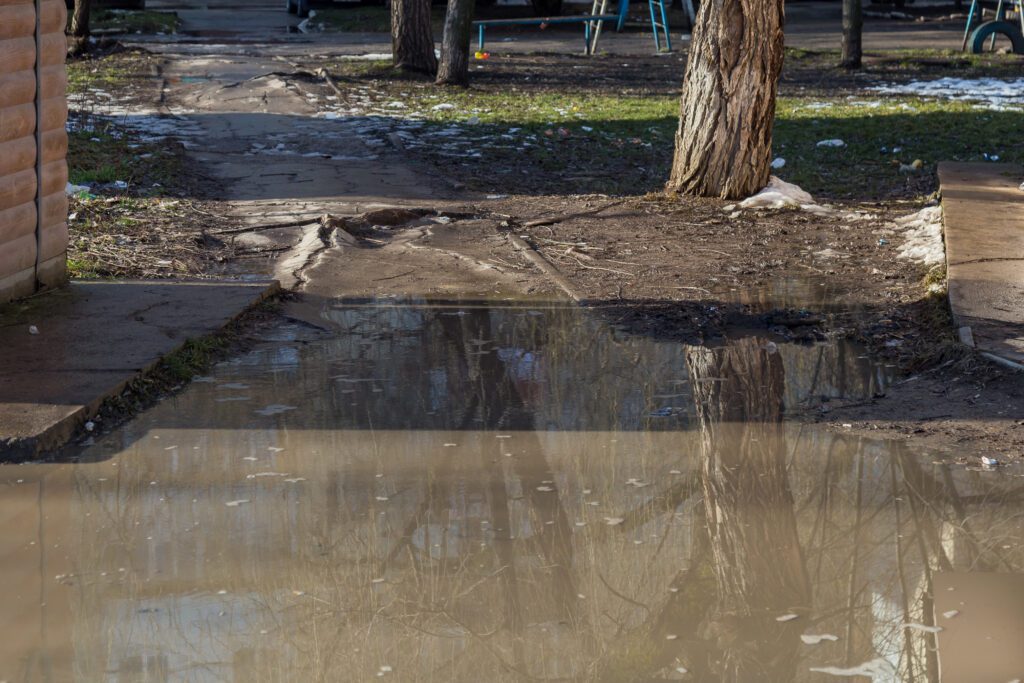
The location and pattern of standing water can offer useful clues about its cause. Use the chart below to identify what to inspect before deciding which solution to try.
| What you notice | Possible cause | What to check | Possible solution |
|---|---|---|---|
| Puddles repeatedly form in the same depression | Low spots or uneven grading | Compare the ground level around the puddle and observe where water flows | Correct minor low spots or consider regrading |
| Water flows toward the house | Poor grading or concentrated runoff | Check the slope beside the foundation and nearby downspouts | Correct the grade or redirect runoff safely |
| The lawn remains soggy even when visible puddles disappear | Compacted or clay-heavy soil | Compare soil infiltration in wet and dry areas | Consider aeration, soil improvement, or drainage assessment |
| Water pools beneath a downspout | Concentrated roof runoff | Inspect gutters, downspout connections, and the discharge point | Extend or reroute the downspout appropriately |
| A strip beside a fence or property boundary remains wet | Low ground, runoff from another area, or a restricted outlet | Observe how water enters and leaves the strip | Assess grading, a swale, or a suitable drainage system |
| Water collects along a driveway or patio | Runoff from hardscaping | Watch the direction of flow across the paved surface | Consider a channel drain, catch basin, or grading adjustment |
| Several parts of the yard stay wet for days | Widespread saturation, multiple runoff sources, or high groundwater | Map the affected areas and check whether they share a common low point | Arrange a broader drainage assessment |
| A previously effective drain no longer works | Blockage, damage, or inadequate capacity | Check accessible grates, inlets, and outlets | Inspect, clean, or repair the existing system |
| Soil washes away or channels form after storms | Concentrated surface flow and erosion | Identify where water enters, speeds up, and exits | Stabilise the flow path and correct the runoff problem |
These symptoms are clues, not definitive diagnoses. For example, a low spot can collect water because of poor grading, but slow-draining clay soil may make the problem worse. In some yards, more than one issue needs to be addressed.
A useful starting point is to observe the yard during and after rainfall. If water consistently flows into one low area, investigate the grade first. If the ground is already sloped appropriately but remains saturated, look more closely at soil infiltration and subsurface drainage.
Why Standing Water Deserves Prompt Attention
It is easy to treat a soggy corner of the yard as a seasonal inconvenience, but the downstream effects of unmanaged standing water can be significant.
Health and pest concerns. Standing water can provide breeding habitat for mosquitoes. Some species can develop in relatively small amounts of stagnant water, so it is worth emptying containers and addressing persistent pools around the property. Reducing standing water helps limit potential breeding sites.
Structural risks. Constant soil saturation near your home’s foundation can contribute to moisture problems and, depending on soil conditions, cycles of expansion and contraction. Over time, poor drainage may contribute to foundation movement, cracks, and water intrusion into basements and crawl spaces. If water repeatedly collects beside the house, take the issue seriously. Ware Landscaping’s article on the causes of basement water damage provides relevant background on how unwanted moisture can affect a home.
Landscaping damage. Grass and ornamental plants can suffer when their root zones remain waterlogged for extended periods. The result may be dead patches, bare soil, root damage, and accelerated erosion, all of which can compound the original drainage problem.
Environmental responsibility. Excess surface runoff can carry fertilisers, pesticides, pet waste, soil, and other pollutants into storm drains and local waterways. Managing water on your own property can help reduce unnecessary runoff and protect the surrounding environment.
How to Identify the Source of Your Drainage Problem
A precise diagnosis leads to a better solution. Before taking any action, take time to observe your property and look for patterns.
Walk your yard during or after heavy rain
Note exactly where water collects, how long it remains, and whether it seems to be coming from your own roof runoff, from neighbouring lots, or from surface flow across your lawn.
Pay attention to the direction water travels. Does it flow downhill into a depression? Does it spread out from a downspout? Does it collect beside a paved surface? These details can help distinguish a grading problem from an issue with soil infiltration or an existing drainage system.
Check your gutters and downspouts
Clear any debris, confirm that downspouts are securely attached and directing water away from the foundation, and look for signs of overflow along the gutter line.
If the problem occurs only during heavy rain, consider whether a gutter or downspout is overflowing or concentrating more water in one area than the ground can handle.
Assess your soil
Soil that absorbs water slowly can contribute to standing water, particularly when combined with poor grading. A simple soil infiltration test can help you compare a problem area with a part of the lawn that drains normally.
Rather than relying only on whether a hole drains within a few hours, use the repeatable method below to observe how quickly water levels fall.
Look for signs of erosion
Exposed roots, channels carved into the lawn by water flow, displaced mulch, and bare patches in the grass are all indicators that water is moving across the surface rather than soaking in.
Erosion can also reveal where water is travelling too quickly or being concentrated at a particular point.
Inspect existing drainage systems
If your property already has French drains, catch basins, or dry wells, check accessible inlets and outlets for clogs, sediment buildup, or damage. A drainage system that worked well years ago may simply need to be cleaned, repaired, or extended.
Do not assume that every blocked or ineffective system needs to be replaced. First establish whether the existing installation is in good condition and appropriate for the amount and type of water it needs to handle.
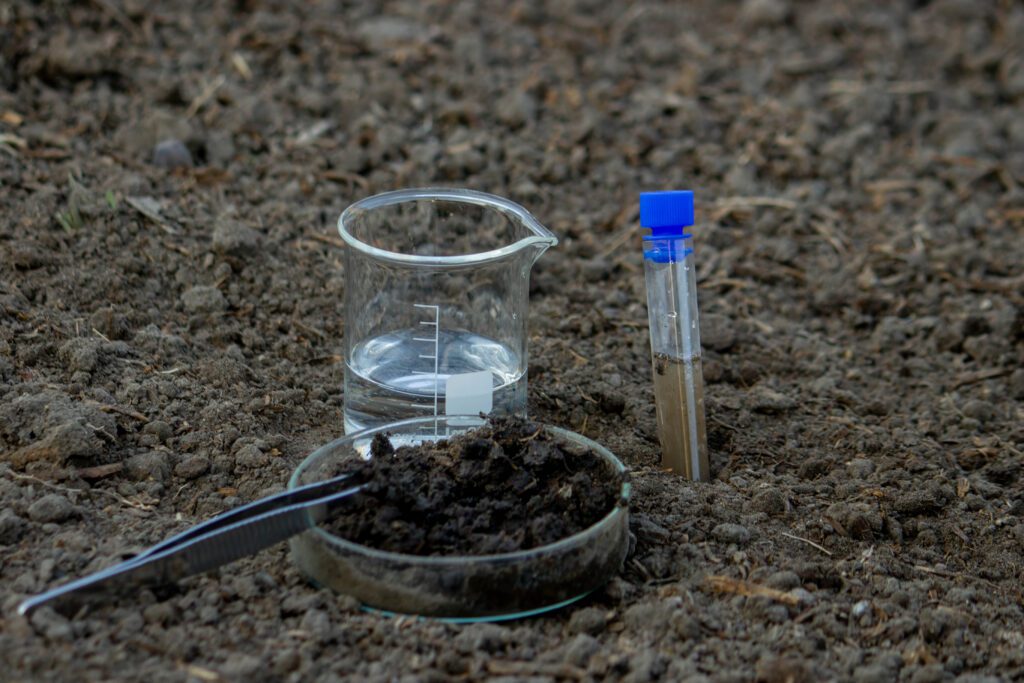
How to Perform a Soil Infiltration Test
A soil infiltration test helps you understand how readily water enters the ground. It will not identify every drainage problem, but it can show whether the soil in a wet area absorbs water more slowly than the soil elsewhere in the yard.
What you will need
- A straight-sided metal can with both ends removed, or a suitable infiltration ring
- A ruler
- Water
- A timer or phone stopwatch
- A notebook to record the results
Step 1: Choose two test locations
Select one area where water regularly collects and, if possible, another part of the lawn that drains normally. Comparing the two results gives you a more useful picture than testing only the wettest spot.
Avoid testing during active rainfall or when the entire yard is already heavily saturated. Record the recent weather conditions because the amount of moisture already in the soil can affect the result.
Step 2: Insert the can into the soil
Push the open-ended can approximately 2 to 3 inches into the ground, keeping it as level as possible. Press gently around the outside to reduce the chance of water escaping along the edges.
Be careful when working near buried services. Before digging or inserting equipment into the ground, check for underground utilities and follow local safety requirements.
Step 3: Pre-wet the soil
Pour a measured amount of water into the ring and allow it to infiltrate. Pre-wetting helps reduce the influence of unusually dry surface soil on the first measurement.
If the water drains very quickly, add more water and allow the area to settle before conducting the timed test.
Step 4: Measure the infiltration rate
Refill the ring to a measured water depth, such as 1 inch. Start the timer and record how much the water level falls over a set period, such as 15 minutes.
For example, if the water level drops by half an inch in 15 minutes, record that observation. Repeat the test to see whether the result is similar.
For a more consistent comparison, use the same ring size, water depth, test duration, and procedure at both locations. A simple ring test is useful for comparing areas, but its result should not be treated as a formal engineering assessment of the entire property.
Step 5: Compare the results
Record your observations using a table like this:
| Test location | Starting water depth | Water-level drop | Observation |
|---|---|---|---|
| Area where water collects | 1 inch | Record your result | Does the water infiltrate slowly or quickly? |
| Area that normally drains well | 1 inch | Record your result | Compare its infiltration with the problem area |
If the wet area absorbs water noticeably more slowly than the comparison area, local compaction or differences in soil structure may be contributing to the problem. If both areas absorb water slowly, the issue may be more widespread.
If the soil absorbs water reasonably well but a puddle still forms in the same place, the yard’s slope or the route of surface runoff may be the more important factor.
What the test cannot tell you: A slow infiltration rate does not automatically mean you need a French drain. It also does not establish whether groundwater is high or whether the property has an appropriate outlet for collected water. Use the result alongside your observations of grading, runoff, and how long the yard remains wet.
Solutions: From Simple DIY Fixes to Professional Installations
There is no single answer to yard drainage. The right solution depends on the severity of the problem, the size of the affected area, and the underlying cause. What follows is a practical range of options, starting with the most accessible and moving toward more involved interventions.
Simple, Low-Cost Starting Points
Let the lawn dry out and adjust irrigation. If the waterlogging appears after routine watering rather than only after rain, the problem may be overwatering. Pause irrigation for several days if conditions allow and see whether the issue resolves. Adjust your watering schedule to match the actual needs of your lawn rather than following a fixed routine.
Redirect your downspouts. Simple extensions or suitable piping can move downspout discharge farther from your foundation and lawn. This is often one of the most cost-effective drainage improvements when roof runoff is the main problem. Make sure the water is directed to an appropriate location and does not simply collect elsewhere.
Fill low spots. Small depressions and basins in the lawn are frequent collection points for water. A minor, isolated low spot may be filled with suitable topsoil, lightly levelled, and reseeded. However, check the surrounding slope first. Filling a low spot without considering the larger drainage pattern can redirect water toward the house or a neighbouring property.
Aerate the lawn. Core aeration creates small holes throughout the lawn that can reduce compaction, improve air exchange, and help water enter the soil. It is often performed in early autumn or spring, depending on the grass type and local conditions, and can be useful for compacted lawns.
Leave the removed soil plugs on the surface so they break down naturally and return soil material to the lawn. Aeration is most helpful when compaction is part of the problem; it will not fix an incorrect slope or a high water table on its own. The benefits of improving lawn soil structure are also relevant to organic lawn care practices.
Topdress with compost. After aeration, applying a thin layer of suitable compost can improve soil structure over time. The right material and application depend on the existing soil and lawn. Avoid adding sand alone to heavy clay soil without a suitable plan, as the result may not improve drainage as intended.
Apply gypsum only when appropriate. Gypsum is sometimes recommended for particular sodic soils, but it does not automatically improve every clay soil. Before using it, establish whether your soil would benefit from the amendment. Soil testing or advice from a local extension service can help prevent unnecessary applications.
Mulch problem areas. Applying around 2 to 3 inches of organic mulch around suitable plantings can reduce erosion, moderate soil moisture, and improve the appearance of a problem area. Mulch is not a substitute for correcting a serious drainage issue, and it should be kept away from siding and building materials to avoid moisture-related problems.
Intermediate Solutions
Build a rain garden. A rain garden is a shallow, landscaped depression planted with suitable water-tolerant species. During rain events, runoff flows into the garden, where plants and appropriate soil allow it to infiltrate gradually.
Rain gardens can work well when positioned to intercept water flowing from a downspout or paved surface. Plant choices should suit the site, local climate, and moisture conditions. Native plants are often a good starting point. The garden also needs a safe overflow route for periods of heavy rainfall.
Do not place a rain garden close to the foundation or assume it will solve every flooding problem. Soil infiltration, groundwater, utilities, property layout, and local requirements all matter when choosing its location.
Build a dry creek bed. A decorative stone-lined channel can guide water away from problem areas along a defined route. With suitable stone, gravel, plants, and erosion control, a dry creek bed can function as both a drainage feature and a landscape element.
It is well suited to yards where water predictably flows across the surface after rain. However, it needs to lead somewhere appropriate. A decorative channel that ends in another low spot may simply relocate the pooling.
Install a rain barrel. Rain barrels placed under downspouts capture some roof runoff before it reaches the lawn, reducing the volume of water the drainage system needs to manage during smaller rainfall events. They also provide water for garden irrigation.
A rain barrel has limited capacity, so it should not be treated as the sole solution for a major drainage problem. Ensure that overflow has a safe route away from the foundation.
Switch to permeable hardscaping. Replacing suitable concrete or asphalt areas with permeable pavers, gravel, or other permeable surfaces can allow more rainwater to filter through rather than run off. This may be particularly useful for driveways, patios, and pathways adjacent to the lawn.
The underlying base material and soil must be suitable for infiltration. Permeable paving may not perform as expected if it is installed over poorly draining soil without adequate design.
Plant water-tolerant vegetation. In persistently wet areas, suitable moisture-tolerant plants can improve the appearance of the space while tolerating conditions that stress ordinary lawn grass. Depending on the site, options may include appropriate sedges, swamp milkweed, blue flag iris, or other locally suitable species.
Plants can support a well-designed landscape drainage plan, but they should not be expected to absorb unlimited runoff or replace a drainage system where one is needed.
Professional-Grade Drainage Solutions
When DIY measures are not sufficient, or when the cause of the problem involves grading, soil structure, or drainage infrastructure, professional installation can provide a more reliable and lasting solution.
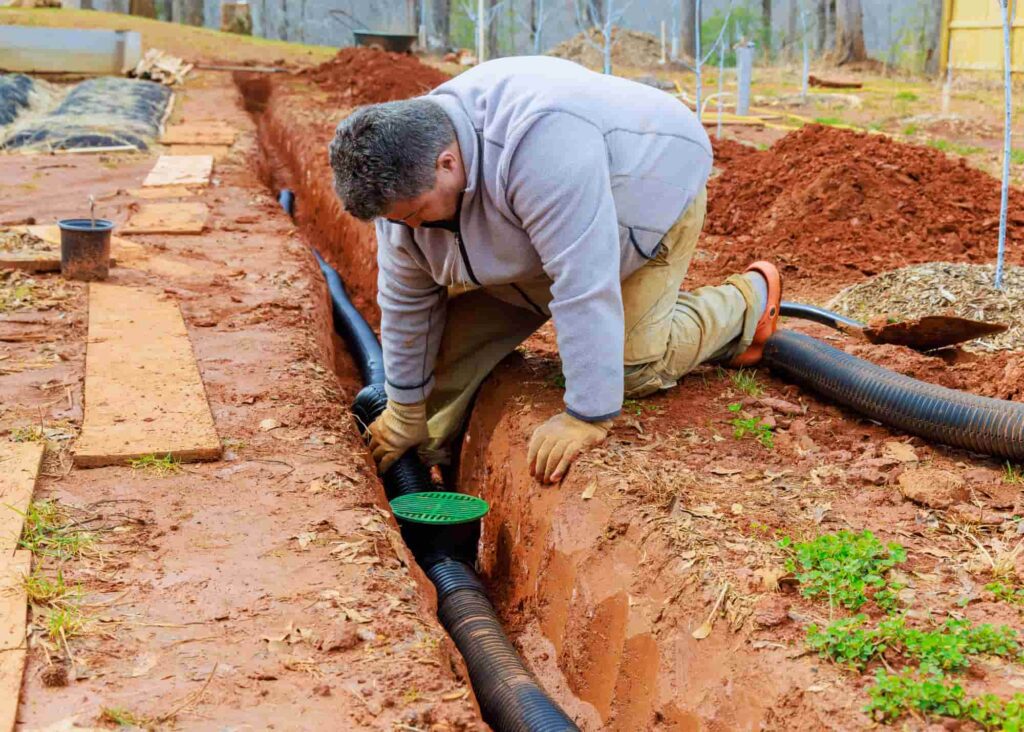
French drain installation. A French drain is an underground system that typically uses a gravel-filled trench and perforated pipe to collect excess subsurface water and direct it toward an appropriate outlet. It can be effective for certain saturated lawn areas and persistent pooling.
The design must account for the location and depth of the water, soil conditions, trench slope, pipe capacity, and outlet placement. Not every wet lawn needs a French drain, and installing one without a suitable discharge route can lead to continued problems.
Yard regrading. When the fundamental problem is the shape of the land itself—a flat yard, a yard that slopes toward the house, or one with significant low-lying depressions—a landscaping professional can reshape the terrain to guide water toward appropriate drainage points.
The work may require grading equipment and should include consideration of the surrounding landscape, structures, existing trees, erosion control, and the final destination of the runoff. Proper regrading can sometimes solve the problem without an underground drain, but larger or more complex sites may need a combination of methods.
Dry well installation. A dry well is an underground structure that collects water and allows it to disperse into the surrounding soil. It can be useful for certain downspout discharge situations and smaller runoff volumes.
Dry wells work best when the surrounding soil can accept the water and the installation is correctly sized. They are not suitable for every soil type or property, particularly where groundwater is high or infiltration is poor.
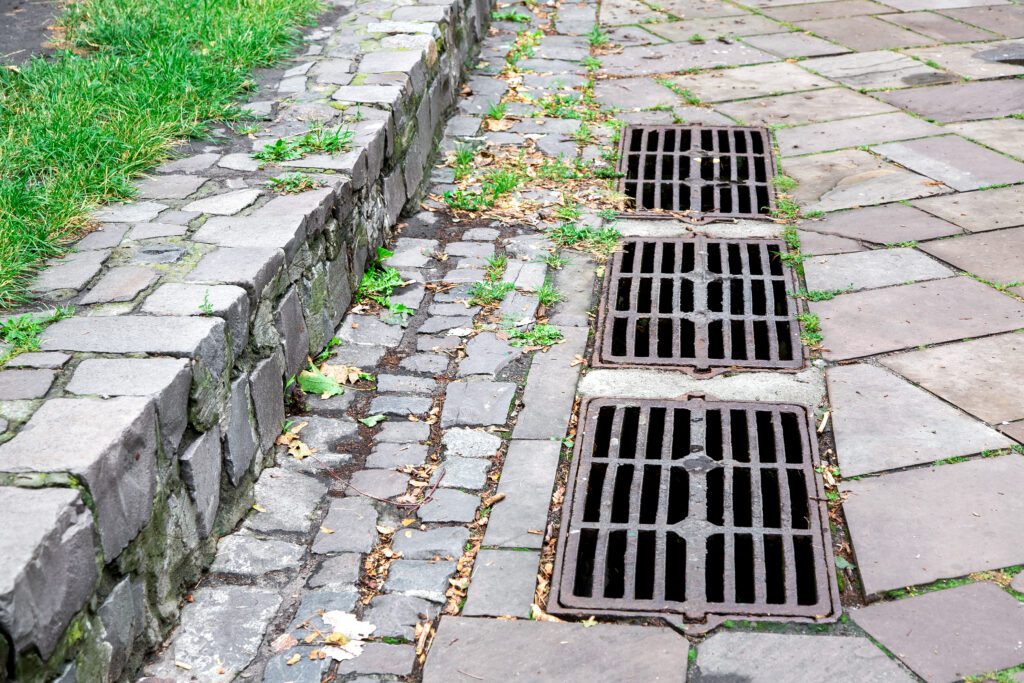
Catch basins and channel drains. Catch basins are grated surface inlets that collect water and route it through underground pipes to a discharge point. Channel drains, sometimes called trench drains, are long, narrow grated channels suited to driveways, walkways, and paved areas where water accumulates across a linear surface.
Both systems can help intercept surface runoff. The location, capacity, pipe routing, and outlet must be appropriate for the volume of water being collected.
Sump pump systems. In some properties with persistent groundwater or recurring water accumulation, a sump basin and pump may be part of a wider drainage plan. The basin collects water, and the pump moves it to a suitable discharge point when the water reaches a set level.
Sump pumps are not a universal solution for outdoor pooling. The source of the water, installation requirements, power supply, maintenance needs, and discharge location should all be assessed before choosing this approach. Learn more about the components involved in installing a sump basin and sump pump.
Pop-up emitters and curtain drains. Pop-up emitters connect to underground drainage pipes and release water at a designated outlet. Curtain drains are shallow drainage systems designed to intercept subsurface water before it reaches a particular area. Their suitability depends on the direction of water movement and the availability of an appropriate outlet.
Should You Install a Drain or Regrade Your Yard?
Regrading and drainage systems solve different problems. Regrading changes the shape of the land so water flows in a more suitable direction. A drain collects or intercepts water and carries it to an appropriate discharge point.
Use this decision tree to narrow down which approach may be suitable for your property.
Step 1: Is a downspout or paved surface sending water into the problem area?
- Yes: Start by correcting the source of the runoff. Clear gutters, check downspout connections, and consider a suitable extension or drainage route. Then observe the area after the next rainfall.
- No or unsure: Move to Step 2.
Step 2: Does the yard visibly slope toward the house or contain a recurring low spot?
- Yes: Regrading may be needed to redirect surface water. Small, isolated depressions may be correctable with careful levelling, while broader slope problems usually require a more comprehensive assessment.
- No: Move to Step 3.
Step 3: Does the yard have a reasonable slope, but the soil stays saturated?
- Yes: Perform a soil infiltration test and consider whether the soil is compacted or naturally slow-draining. If water needs to be collected and carried away, a suitable subsurface drainage system may be appropriate.
- No or unsure: Move to Step 4.
Step 4: Does water collect along a driveway, patio, or other paved surface?
- Yes: A channel drain or catch basin may be suitable for collecting surface runoff. Grading changes may also be needed to direct the water toward the inlet.
- No: Move to Step 5.
Step 5: Does water remain for days, appear during dry weather, affect several areas, or enter the basement?
- Yes: Arrange a professional assessment before choosing a system. Groundwater, multiple runoff sources, or more complex drainage conditions may be involved.
- No: Start with the simplest appropriate correction, monitor the results, and reassess after rainfall.
What the decision tree means in practice
| Situation | Option to investigate first | Why |
|---|---|---|
| A small, isolated lawn depression collects water | Minor levelling or local grading correction | The low spot may be trapping surface runoff |
| The ground slopes toward the foundation | Professional grading assessment | The shape of the land may be directing water toward the house |
| The soil is compacted but the yard has a suitable slope | Aeration or appropriate soil improvement | Water may be entering the soil too slowly |
| A paved area directs runoff toward the lawn | Surface drainage and grading | The water may need to be intercepted before it spreads |
| Water continues to saturate a defined area | Assessment for a French drain or another suitable system | Subsurface water may need to be collected and redirected |
| Several drainage issues occur together | Combined grading and drainage plan | A single intervention may not address every source |
The key is to avoid choosing a drainage system before identifying the source of the water. A drain in the wrong location may miss the problem entirely, while filling a low spot without considering the surrounding grade can send water somewhere else.
For a closer look at available options, Ware Landscaping’s guide to yard drainage solutions explains common approaches to managing excess water.
Cost Overview
The cost of fixing yard drainage varies according to the size of the affected area, soil conditions, site access, materials, labour, and the complexity of the installation. The following ranges are estimates from the original guide and should be treated as general planning figures, not a current quote for a particular property.
| Solution | Approximate Cost Range | Best For |
|---|---|---|
| Lawn aeration | $50–$100 (DIY rental) | Compacted soil and minor drainage improvement |
| Compost topdressing | $30–$50 per cubic yard | Soil amendment after aeration |
| Rain garden | $500–$3,000 | Surface runoff and ecological drainage |
| Dry well | $300–$1,200 (DIY) | Downspout discharge and minor pooling where soil infiltration is suitable |
| French drain | $1,000–$5,000 (professional) | Certain saturated lawn areas and subsurface drainage problems |
| Yard regrading | $1,500–$5,000 | Poor slope and broader surface-water management |
| Catch basin system | $1,500–$4,000 | Surface water collection and routing |
| Full drainage system | $4,000–$15,000 | Severe or multi-source flooding |
These ranges will vary depending on yard size, soil conditions, local labour rates, materials, and installation complexity. Actual costs may fall outside them, especially where excavation, difficult access, extensive restoration, or complex discharge requirements are involved.
The best way to avoid unnecessary spending is to establish the cause of the drainage problem before choosing a solution. A small correction may be enough for a minor low spot, while a yard with poor grading and persistent subsurface saturation may need more than one intervention.
Eco-Friendly Approaches to Drainage
Sustainable drainage solutions are often effective when they are matched to the site’s conditions, and they carry additional benefits for the local environment.
Rain gardens and bioswales can help manage runoff and filter some pollutants before water infiltrates or moves toward a designated drainage route. Native plantings support pollinators and may require less ongoing maintenance than unsuitable ornamental alternatives. Permeable paving can reduce runoff from appropriate hardscaped areas, while rain barrels capture some roof runoff for later garden use.
Mulch and compost can also improve soil structure over time when used appropriately. However, these approaches should be considered part of an overall drainage plan rather than substitutes for correcting a serious slope problem or managing groundwater.
In Illinois, local stormwater requirements may affect the design and location of a rain garden, drainage outlet, or other landscape feature. Check the applicable rules before undertaking a larger project.
Long-Term Maintenance
A drainage system, whether DIY or professionally installed, performs best when it is maintained consistently.
- Inspect gutters and downspouts at least twice per year and after major storms.
- Clear debris from accessible catch basins, grates, and drainage inlets seasonally.
- Aerate and overseed the lawn when appropriate for the grass type and local growing conditions.
- After heavy rainfall, walk your yard to identify new areas of concern or signs of erosion.
- Keep drainage routes and outlets clear of leaves, sediment, and other obstructions.
- Monitor areas where water repeatedly collects, even after a repair.
- For sump pump systems, test the pump periodically and ensure the discharge outlet remains clear.
Consistent maintenance helps prevent small issues from developing into larger ones and extends the useful life of a drainage investment.
When to Call a Professional
Many drainage issues are accessible to a capable homeowner with the right tools and some patience. Others require a more detailed assessment.
Consider professional help when:
- Flooding is persistent and has not responded to simpler fixes.
- Water is pooling near your foundation, entering your basement, or threatening structural elements.
- The problem involves grading across a large area.
- Several parts of the yard remain wet even during dry weather.
- An existing drainage system appears blocked, damaged, or unable to manage the runoff.
- You suspect that groundwater or soil conditions are contributing to the problem.
- Local regulations or permit requirements apply to your drainage project.
- You are unsure about the location of buried utilities or the safety of the proposed excavation.
Stop Your Backyard From Becoming a Swamp
A soggy lawn is a sign of a failing landscape. Don’t settle for a swampy yard that breeds mosquitoes and kills your grass—get a professional drainage system engineered to keep your property bone-dry.
Get a Free QuoteIn Illinois, contact 811 before digging so underground utility lines can be marked. A qualified drainage contractor can assess the site’s slope, soil conditions, runoff sources, existing drainage infrastructure, and potential discharge routes before recommending an installation.
If you are unsure whether your yard needs regrading, a French drain, a catch basin, or a combination of solutions, Ware Landscaping’s drainage services are a relevant starting point.
Frequently Asked Questions
What is considered a drainage problem in a yard?
A drainage problem exists when water accumulates and does not disperse within a reasonable period after rain. Signs include persistent puddles, consistently soft or waterlogged soil, grass or plants that fail to thrive in certain areas, soil erosion channels, and water entering the basement or foundation area. If water remains on your lawn 24 to 48 hours after ordinary rainfall, it is worth investigating, although the appropriate drying time depends on the soil, rainfall, and site conditions.
How do I fix low spots in my yard that collect water?
For small, isolated depressions, adding suitable topsoil, levelling carefully, and reseeding may be effective. For larger or recurring low spots, the underlying cause whether poor grading, compacted soil, or inadequate drainage infrastructure needs to be addressed to prevent the problem from returning.
What is the best way to fix a swampy backyard?
The right approach depends on the source of the moisture. For surface-level compaction, aeration and appropriate soil improvement may help. For water collecting because of poor grading, a grading correction may be more appropriate. Persistent saturation may require a French drain or another drainage system. Some yards need a combination of grading, soil improvement, and drainage installation.
How much does it cost to fix yard drainage?
Costs range significantly based on the scope and nature of the work. Minor DIY fixes such as aeration or simple downspout adjustments may cost relatively little. Rain gardens and dry wells can require greater investment, while professional French drains, catch basins, and comprehensive regrading can cost several thousand dollars. The estimates in this guide are general planning figures; obtain a site-specific quote before committing to work.
Can standing water in my yard damage my foundation?
Persistent water near your foundation can increase the risk of moisture intrusion and may contribute to soil movement depending on local conditions. Water entering a basement, visible foundation cracks, or recurring pooling beside the house should be investigated rather than treated as a cosmetic lawn issue.
Is it possible to fix yard drainage without regrading the entire lawn?
In many cases, yes. Correcting downspout discharge, addressing minor compaction, or installing a suitable drainage system may resolve a localised problem without reshaping the whole yard. However, if the fundamental issue is that the land directs water toward the house or into unavoidable low points, regrading may be the more effective long-term solution.
Are rain gardens effective for managing yard flooding?
Rain gardens can help manage moderate runoff where water collects predictably and the soil and site are suitable. They need appropriate sizing, suitable plants, and a safe overflow route. They are not typically sufficient as the sole solution for severe flooding, groundwater problems, or water threatening a home’s foundation.
What three methods most effectively improve poor yard drainage?
Three important methods are aeration to address suitable cases of soil compaction, grading adjustments to redirect surface water, and a drainage system such as a French drain or catch basin where water needs to be collected and moved. The most effective option depends on the cause of the problem, and some yards benefit from combining methods.
How can I tell whether I need a French drain or regrading?
Start by observing where water collects and how it travels. If the yard’s slope directs water into a low spot or toward the house, regrading may be needed. If the slope is suitable but the ground remains persistently saturated, a drainage system may be appropriate. If both conditions are present, a combined solution may be necessary. A professional site assessment can help confirm the right approach.
Final Thoughts
Standing water in your yard is more than an inconvenience. It can damage grass, create muddy areas, encourage mosquito breeding, and contribute to moisture problems around your home. The most effective way to fix it is to identify the cause before choosing a solution.
Start by observing the yard after rainfall, checking your gutters and downspouts, looking for low spots, and comparing how quickly water enters the soil in wet and dry areas. Use those findings to determine whether a simple adjustment, soil improvement, regrading, a drainage system, or a combination of solutions is most appropriate.
If the water keeps returning, affects several areas, or collects near your foundation, avoid relying on trial-and-error fixes. Explore Ware Landscaping’s drainage services to discuss a solution suited to your property’s conditions.