
When you are staring at a soggy lawn or a damp basement wall in 2026, you know you need a solution that won’t fail after the first heavy storm. For over a century, the French drain has been the gold standard for property drainage. However, the success of this system hinges on one critical technical detail: Installation depth.
Dig too shallow, and you’re essentially burying money in the mud. Dig too deep without an engineered plan, and you risk damaging your foundation or hitting vital utility lines. At Ware Landscaping, we specialize in “one-and-done” drainage solutions. In this 2026 guide, we’ll explore the ideal depths for modern drainage scenarios, how soil composition dictates your strategy, and why depth is the most important factor in your ROI.
If your French drain isn't deep enough to capture the water table, your yard will stay underwater. Stop the DIY guesswork and get a high-capacity, engineered system that actually works.A Shallow Drain is a Total Waste of Money
The 2026 Short Answer: The “Sweet Spot”
For the average residential property in 2026, the standard depth for a French drain is 18 to 24 inches. This depth is deep enough to intercept subsurface water before it saturates your topsoil but shallow enough to allow for efficient excavation. However, as extreme weather patterns become more frequent, “average” doesn’t always cut it. Your specific depth will vary based on your goal, your soil, and your local climate.
Factor 1: The Goal of Your Drain
The problem you are solving determines how deep we have to dig. In 2026, we categorize these into two main types:
Surface Water Management (10–15 inches)
If your issue is standing water in low spots after a quick downpour, you likely need a Curtain Drain. These are shallower (8 to 15 inches deep) and are designed to catch surface runoff quickly. In 2026, we often pair these with high-flow Geocomposite fabrics to ensure they don’t clog with fine silt.
Groundwater & Foundation Protection (24–72 inches)
If you have a wet basement or crawlspace, the stakes are much higher. You are fighting hydrostatic pressure. To protect a foundation, the drain must be installed at or below the level of the footing.
- Standard Foundation Drain: Typically 24 to 48 inches deep.
- Deep Weeping Tiles: In some 2026 builds, these can reach depths of 6 to 8 feet to ensure groundwater never reaches the slab.
Factor 2: Soil Composition & 2026 Pricing
The “dirt” in your yard dictates how water moves. In 2026, labor and material costs for deep drains are influenced heavily by soil type:
| Soil Type | Recommended Depth | 2026 Cost Note |
| Heavy Clay | 24″ – 36″ | Requires more gravel backfill; higher labor cost |
| Sandy / Loam | 12″ – 18″ | Fast drainage; most affordable to install |
| Rocky / Hardpan | 18″ – 24″ | Requires heavy machinery (trenchers/excavators) |
Retaining Wall Connection: If you are installing a French drain behind a retaining wall (a common 2026 request to preserve wall integrity), expect to pay $25 – $55 per linear foot depending on the depth and accessibility.
Factor 3: Climate and the Frost Line
In regions like the Midwest or Northeast, the frost line is a major factor. If your French drain is too shallow (above the frost line), the water inside the pipe can freeze, causing the system to backup during a spring thaw—exactly when you need it most.
- Pro Tip for 2026: For critical foundation protection, we always aim to install below the local frost line (often 36″+ in colder states) to prevent “heaving” or pipe separation.
2026 Installation Standards: The “Burrito” Method
A functional French drain is a system, not just a ditch. At Ware Landscaping, we follow a strict protocol:
- Safety First: We always call 811. In 2026, fiber optic and smart-grid lines are buried at varying depths; hitting one is an expensive mistake.
- The 1% Slope: A deep hole is useless if it’s flat. We use laser-levels to ensure a continuous downhill grade of at least 1 inch of drop for every 10 feet.
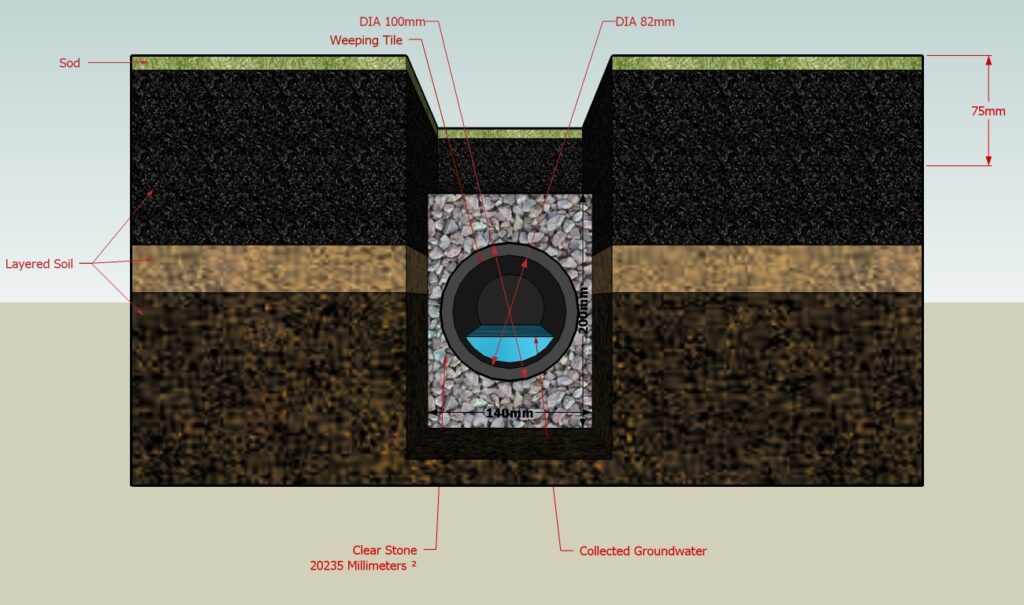
- The Layered Wrap: We line the trench with non-woven geotextile fabric, add a 3-inch base of washed angular stone, lay 4-inch perforated PVC (holes facing down), and “burrito wrap” the system to keep soil out forever.
Common Mistakes: Why Drains Fail in 2026
Most of our “repair” calls stem from two issues:
- The “Flat” Drain: Homeowners often follow the surface terrain rather than a calculated slope, creating underground pockets of stagnant water.
- Insufficient Depth: A 6-inch “trench” might hide a pipe, but it won’t lower the water table. If you can hit your drain pipe with a lawn aerator, it’s too shallow.
When to Call the Professionals
Digging a 100-foot trench at a 24-inch depth involves moving over 5 tons of earth and stone. Beyond the physical labor, the engineering calculating the hydraulic gradient and ensuring your “daylight” exit point is viable is where DIY projects often fail.
At Ware Landscaping, we don’t just dig; we solve. Whether you are dealing with a “swampy” backyard or a compromised foundation, our 2026 drainage assessments use soil-stress analysis and precision grading to keep you dry for decades.
If your French drain isn't deep enough to capture the water table, your yard will stay underwater. Stop the DIY guesswork and get a high-capacity, engineered system that actually works.A Shallow Drain is a Total Waste of Money
Stop guessing and start draining. Request Your Professional Drainage Assessment Today.