
Keeping a lawn and garden looking nice goes beyond just letting water out of the hose. Effective watering means understanding how much water your plants need, where that water is going to, and how to refine your watering to be both efficient and effective.
Many gardeners struggle to determine if they are using the right amount of water because hose watering may take five, ten, or twenty minutes, and that’s not a true measure of how much watering is getting done. Water pressure, diameter, nozzle settings, irrigation equipment, and more can all affect how efficiently water is delivered to the lawn or garden.
With garden water usage data, landscape management can be both sustainable and healthy.
Why Measuring Garden Water Usage Matters
From a watering perspective, plants need adequate moisture, but more water is not necessarily better and can result in loss of nutrients, saturated soil, and an unhealthy lawn. A lawn and plants can also become damaged from not enough water resulting in dry soil and wilting plants.
As such irrigation management is a key step in lawn and garden maintenance.
Instead of throwing a guess at how much watering is needed based on how much time you water, a much more precise method is using a volumetric measure as you water a garden, a lawn, or an individual plant.
Measure Water Flow Instead of Guessing
To get a sense of outdoor water consumption, we can examine the water passing through a garden hose.
Garden hose water flow meter let individuals measure their water consumption during outdoor watering. Gardening by the hose can be difficult. There are so many factors to consider for the many different areas in your garden and lawn. With a water meter, gardeners can understand their water consumption and supposedly be more efficient with their watering of lawns, gardens, and landscaped areas.
This meter can even be used to set a baseline. A garden may require a certain amount of water over a given period of time during a typical watering session. If your consumption continues to increase, something has probably changed in the way you water the garden.
This device is especially valuable during the growing season. Instead of increasing watering time, a gardener can actually base watering duration on water consumption.
Understand That Different Garden Areas Have Different Needs
A proper watering schedule takes into account many factors, like the type of plant, soil health, and placement of the plant in the garden.
A lawn that is in the direct sun will lose moisture faster than a bed that is covered by a canopy. Containers will dry faster than ground plants. Soil that is sandy will dry differently than soil that is clay based.
Every part of the garden will lose moisture at a different rate. So, watering every part of the garden the same length of time will result in the garden being over or under watered.
The answer to this problem may be to group areas of the garden by how much water they need to retain. It may be that the garden needs less water in some areas and more water in others.
For this method, some sections of the garden will always get over watered if other sections need extra water.
Check Your Garden Hose and Connections
The efficiency of outdoor watering systems is dependent on the condition of the equipment.
Check the hoses, connectors, fittings, and high pressure hose nozzle before you begin outdoor watering for the day. The cured water in a hose creates small leaks that will waste time and water when left pressurized over a prolonged period of time.
You should be inspecting for leaks, dripping connections, cracks, worn or damaged washers, and sections of the hose. Leaks may appear insignificant over a single watering session, but can create a considerable amount of water loss over a growing season.
The connections should be tightened to the proper, safe, level, and firmly secure; there should not be over tightened equipment. Worn equipment should be replaced.
These simple, routine equipment checks will also provide greater water management and maintain dependability during your watering session.
Improve Control at the End of the Hose
The term ‘water efficiency’ quantifies the entire system and not just the amount of water traveling through a hose. ‘Water efficiency’, in terms of outdoor watering, would also include the delivery system of the water that is intended for irrigation.
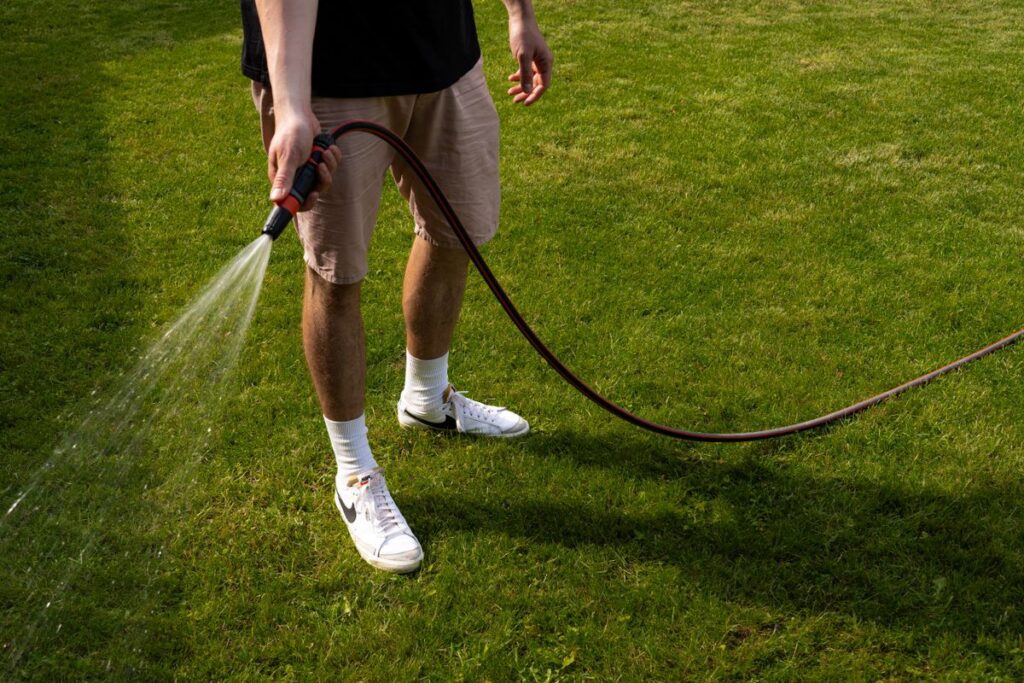
A spray nozzle on your hose with adjustable pressure is recommended for better water delivery to the intended irrigation targets. The spray nozzle can be adjusted to a watering pattern that is intended to irrigate the target area. This eliminates water being wasted to spray on areas that do not need irrigation, including driveways, sidewalks, and other hardened surfaces.
For finer control, concentrated streams may be more appropriate for some outdoor watering applications such as wetting delicate plants.
Increased control of the water delivery system is the goal to reduce wasted irrigation water outside the intended irrigated area.
Water the Soil, Not the Surrounding Surfaces
Watering efficiency can be increased through strategic placement of water to reduce waste.
Spraying water on hard, impenetrable surfaces brings little to no benefit to a garden, and typically wastes water. It is important that irrigation systems are directing water to the soil.
To avoid water waste, when manually watering, move the hose so water is dispersed and falls on the soil to be hydrated.
To promote no water waste, constantly check and adjust the position of the sprinkler heads on the lawn. A little movement of the sprinkler can lead to watering a driveway instead of a lawn.
There are a variety of small changes that can result in a great change to water efficiency over the course of the season.
Consider When You Water
Watering outdoors can be improved through timing.
Water can be lost to waste through evaporation when conditions are hot and the water is exposed. Wind can disperse water to areas other than where it is intended.
Improving watering efficiency is also dependent on local conditions and restrictions on watering.
Gardeners must avoid a rigid watering schedule and be flexible. Changes in the weather, temperature, and moisture in the soil can affect the soil and watering needs.
It is also beneficial to check the soil moisture in the root zone. If the soil in the root zone is still moist, then the garden doesn’t need to be watered.
Use Mulch to Help Retain Soil Moisture
Conservation of garden water relies on more than just irrigation. Conservation of water lost through the soil is also important.
Soil moisture is conserved by mulching. Mulching helps reduce soil evaporation, and different landscape mulches can serve different protective and decorative purposes.
Mulching conserves moisture by slowing the flow of water from the soil to the atmosphere.
While one-time measurement of water used is helpful, watching the garden over an extended period provides a much better idea of water consumption.
Patterns of water consumption will show up over time if the total water used is measured in different areas and compared to growing conditions of various plants.
Monitor Water Usage Over Time
Measurement of total water used during different growing seasons and in different parts of a garden can give a sense of how future maintenance of water supply for different parts of the garden will be like.
For the conservation of water, it is important to check evolution of water using patterns whether they result from a change in watering habits or gaps in garden supply.
Maintaining the garden can be easier when expectations of the watering patterns change with weather conditions.
Avoid Overwatering the Lawn
Lawn irrigation makes up a substantial part of garden irrigation, so lawns are an important monitoring area.
Instead of automated watering, look for signs of required irrigation and consider the recent rain and soil moisture.
How quickly a lawn needs watering is based on the grass type, climate, soil, weather conditions and sun. There is no perfect watering schedule for each and every case.
Measuring water used and looking at lawn conditions is a better approach to irrigation using a schedule rather than just a timer.
Build a More Efficient Outdoor Watering Routine
Improving outdoor watering often does not require advanced irrigation systems. Most of the time it begins with better data and consistent maintenance.
Checking water usage and making sure there are no leaks is very important. Water should be directed to the root zone. The timing and amount of watering should be changed based on the weather and soil condition.
All of these practices can improve the overall garden watering routine.
Appropriate water use in gardens is based on monitoring water consumption and making necessary adjustments to the garden to improve lawns and plants health while reducing outdoor water waste.