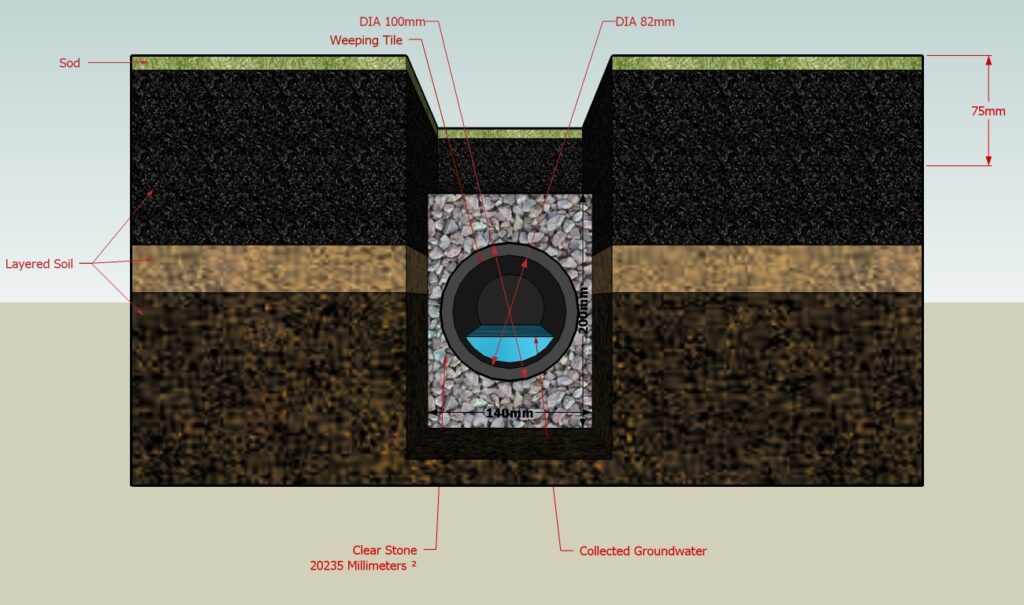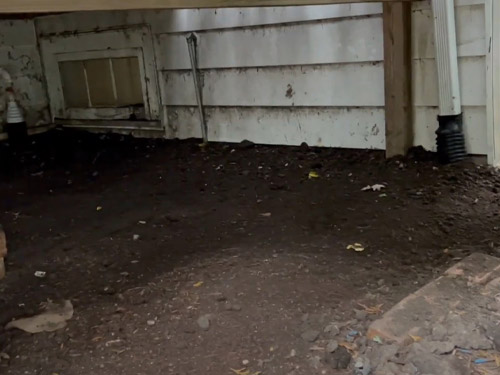

After the summer of 2025 — with multiple flash flood events across the Chicago suburbs and record January 2026 rainfall leaving hundreds of streets flooded — drainage has moved from a nice-to-have to a genuine financial priority for homeowners across the region. The question most people are asking isn’t whether to fix their drainage, but how much it will cost.
Here’s what you should actually expect to budget in 2026, broken down by system type, yard size, and the cost factors that matter most.
What Is the Average Cost of Yard Drainage in 2026?
According to current industry data from Angi and HomeAdvisor, the national average for professional yard drainage installation sits at approximately $4,622, with most projects falling between $2,145 and $7,163.
Stop Throwing Money Down the Drain
Cheap drainage 'fixes' always cost more in the long run when they fail and flood your home. Get a fixed-price, engineered solution backed by our 10-year guarantee.
Get a Free QuoteThat range is wide because “yard drainage” covers everything from a single buried downspout extension to a fully engineered system with multiple catch basins, French drains, and a pump-assisted outlet. Here’s how the extremes break down:
- Simple fixes (downspout burial, short gravel drain): $800–$2,000
- Mid-range systems (French drain, one or two catch basins, standard yard): $3,000–$7,000
- Complex or large-scale systems (pump-assisted, multiple drain types, large property): $10,000–$15,000+
For Chicago-area homeowners specifically, the clay-heavy soils across DuPage, Kane, and Will counties push installation costs toward the higher end of these ranges. Clay requires more excavation time and often dictates a pump-assisted system where gravity drainage alone isn’t sufficient.
Cost by Drainage System Type
Different drainage problems call for different solutions — and each carries a different price tag.
| System | Cost Range | Best Application |
| French Drain (exterior) | $10–$35 per linear foot | Soggy lawn, subsurface water |
| French Drain (foundation/perimeter) | $30–$60 per linear foot | Foundation moisture, basement water |
| Trench / Channel Drain | $30–$150 per linear foot | Driveways, hardscaped surfaces |
| Underground Downspout | $150–$350 per downspout | Roof runoff, gutter management |
| Catch Basin (plastic) | $200–$500 each | Surface pooling, low spots |
| Catch Basin (concrete) | $2,000–$5,000 each | High-volume commercial/large yard |
| Dry Well | $1,600–$4,800 | Subsurface absorption, no outlet available |
| Pump-Assisted System | $3,000–$9,000+ | Flat lots, low-lying neighborhoods |
The pump-assisted system is worth calling out specifically for the Chicago suburbs. Flat lots with no natural slope to drain to — common across Naperville, Wheaton, and Plainfield — cannot rely on gravity drainage alone. A well-and-pump system collects water underground and actively pumps it to an outlet, solving problems that other approaches can’t. These systems run higher but are the difference between drainage that works and drainage that doesn’t on challenging sites.
Cost by Yard Size
Yard size directly drives how much linear footage of drainage you need, which scales material and labor costs accordingly.
| Yard Size | Estimated Drainage Length | Estimated Project Cost |
| 500 sq ft | 50–100 ft | $800–$2,500 |
| 1,000 sq ft | 100–200 ft | $1,500–$5,500 |
| 2,000 sq ft | 200–400 ft | $3,000–$10,000 |
| 2,500+ sq ft | 250–500 ft | $4,000–$15,000+ |
These figures assume standard soil conditions. Clay soil, bedrock, tree root interference, or difficult access (narrow side yards, existing hardscape) increases both labor hours and total cost.
The Five Factors That Most Affect Your Price
- System type and complexity. A single buried downspout is a morning’s work. A pump-assisted French drain with multiple collection points and a storm sewer connection is a multi-day engineered project. Scope drives cost more than any other factor.
- Soil conditions. Chicago-area clay expands and contracts with moisture, making excavation harder and slower than in sandy or loamy soil. Rocky or compacted ground increases both equipment requirements and labor hours.
- Labor rates. Professional drainage contractors in the Chicago suburbs charge between $50 and $150 per hour as of 2026. Labor represents the majority of total project cost — typically 70–80%. This is why getting multiple quotes matters: you’re primarily comparing labor estimates.
- Permits. Many municipalities in DuPage and Kane counties require permits for drainage work that connects to storm sewers or involves significant grading. Permit costs in the Chicago area range from $400 to $2,300 depending on scope and municipality. A reputable contractor pulls permits as a matter of course — if one offers to skip them to save money, that’s a red flag.
- Landscape restoration. Drainage installation requires opening up your yard. Sod replacement, grading, and replanting after the work is done add $200 to $10,000 depending on how much surface area was disturbed and the quality of the finish work.
Additional Costs to Budget For
Beyond the core installation, plan for these line items:
- Excavation and grading: $1,400–$6,000 (if significant regrading is needed)
- Sump pump addition: $600–$2,500 (for systems requiring active pumping)
- Annual maintenance: $100–$400 per professional visit; $50–$200 DIY per year
- Repairs: $200–$700 for minor clogs or outlet issues; $1,000–$3,000 for pipe replacement or major repairs
Well-installed drainage systems last 30 to 40 years with reasonable maintenance. The ongoing cost is modest compared to what deferred maintenance on a failed system requires.
DIY vs. Professional: Where the Line Is
Small drainage fixes — extending a downspout, digging a shallow gravel trench, installing a pop-up emitter — are reasonable DIY projects under $2,000. Materials are readily available and the work doesn’t require precision engineering.
The moment your project involves trenching deeper than 12 inches, connecting to a storm sewer, regrading a meaningful area, or solving a problem on a flat lot, it crosses into professional territory. The reasons are practical: imprecise grading makes drainage worse instead of better, utility lines (call 811 before any digging) run through yards, and an undersized system that can’t handle the rainfall intensities the Chicago area has been experiencing in 2025–2026 is not a solution — it’s an expensive version of the same problem.
Insurance: What’s Covered and What Isn’t
Standard homeowners insurance policies do not cover yard drainage installation. Some policies cover water damage if a system fails, but the drainage system itself is a property improvement, not an insurable structure. If you’re in a flood-prone area or a FEMA-designated flood zone, a separate flood policy may be worth investigating — but it won’t cover the cost of drainage installation either.
The practical takeaway: drainage is a capital expense that pays for itself by preventing foundation damage (average repair: $3,600–$9,500 for retaining walls; $23,000–$48,000 for structural foundation work) and basement flooding (average damage: $10,000–$26,000 per incident).
How to Get the Best Value
Get at least three quotes — and compare scope, not just price. A lower bid that omits the drainage outlet connection, uses lighter-weight pipe, or skips the geotextile fabric will cost more in the long run.
Consider timing. Off-season installation (late fall or early spring in the Chicago area, before the ground freezes) can come with lower rates and faster scheduling than peak summer season.
Bundle with related work. If you’re already planning hardscape, landscaping, or lawn renovation, integrating drainage into the same project eliminates mobilization costs and reduces landscape restoration expenses.
What Does Proper Drainage Actually Protect?
The numbers make the case clearly. A $5,000 drainage system that prevents one basement flooding incident saves at least double that in cleanup, remediation, and replacement costs. A French drain that protects a foundation from 20 years of hydrostatic pressure prevents repair costs that can exceed $30,000. The ROI on proper drainage, in a region experiencing increasingly intense storms, is among the highest of any home improvement investment you can make.
Get an Accurate Quote for Your Property
At Ware Landscaping, we provide free on-site drainage assessments across Naperville, Hinsdale, Wheaton, Barrington, and the greater Chicago suburbs. We diagnose the actual cause of your water problem — not just install a system and hope — and design solutions that account for your specific soil, slope, and the rainfall patterns this region is now experiencing. Every drainage installation is backed by our 10-year drainage guarantee.
Stop Throwing Money Down the Drain
Cheap drainage 'fixes' always cost more in the long run when they fail and flood your home. Get a fixed-price, engineered solution backed by our 10-year guarantee.
Get a Free QuoteSchedule your free consultation today.
Call 630-885-6370 or visit warelandscaping.com