
Most landscapers buy blocks by the pallet. That works well for a single patio or a short garden wall. It works less well when you build walls, edging and raised beds every week, or when you manage a large property with years of hardscape work ahead.
Some contractors and landowners now make part of their own block supply on site. This guide covers machine types, block shapes, mixes and curing, and when a machine beats ordering pallets.
Why Make Your Own Blocks?
It can make sense when several of these apply:
-
You use the same block shapes on many jobs.
-
Delivery to your sites is slow or awkward.
-
You have good sand and gravel close by.
-
Your crew has quiet weeks you want to fill.
-
You manage a farm, estate or large lot with ongoing wall, path and edging work.
It makes less sense if you only build a few patios a year, or if your clients want colored, textured pavers in one exact factory finish.
Machine Types at a Glance
|
Machine type |
How it works |
Best landscape products |
Power |
Good fit for |
|
Manual mobile (egg-laying) |
Crew feeds mix by hand; machine vibrates, then steps forward |
Hollow blocks, solid blocks, simple edging |
Small electric motor |
Small crews, low daily output |
|
Semi-automatic mobile |
Engine-driven vibration; crew still feeds the mold |
Hollow and solid wall blocks |
Electric or diesel |
Sites without mains power |
|
Hydraulic automatic mobile |
Hydraulic press plus vibration; moves at the press of a button |
High volumes of wall and hollow blocks |
Larger electric supply |
Contractors supplying several crews |
|
Compressed earth / clay brick |
Presses damp soil or clay with a little cement |
Interlocking bricks for garden walls and planters |
Electric or diesel |
Rural sites with suitable soil |
|
Stationary pallet machine |
Forms blocks on pallets, then moves them to a curing area |
Pavers, face-mix wall units, curbs |
Fixed power supply |
Permanent yards with indoor space |
Manual Mobile Machines
A manual egg-laying machine is the simplest way in. The crew shovels mix into the mold. The machine vibrates and compacts it. Then it lifts and moves forward, leaving a row of blocks on the slab. It “lays” blocks like a hen lays eggs, which is where the name comes from.
These machines need no pallets, which cuts out a lot of handling. Output is modest, and mix quality depends on your crew.
Semi-Automatic and Diesel Mobile Machines
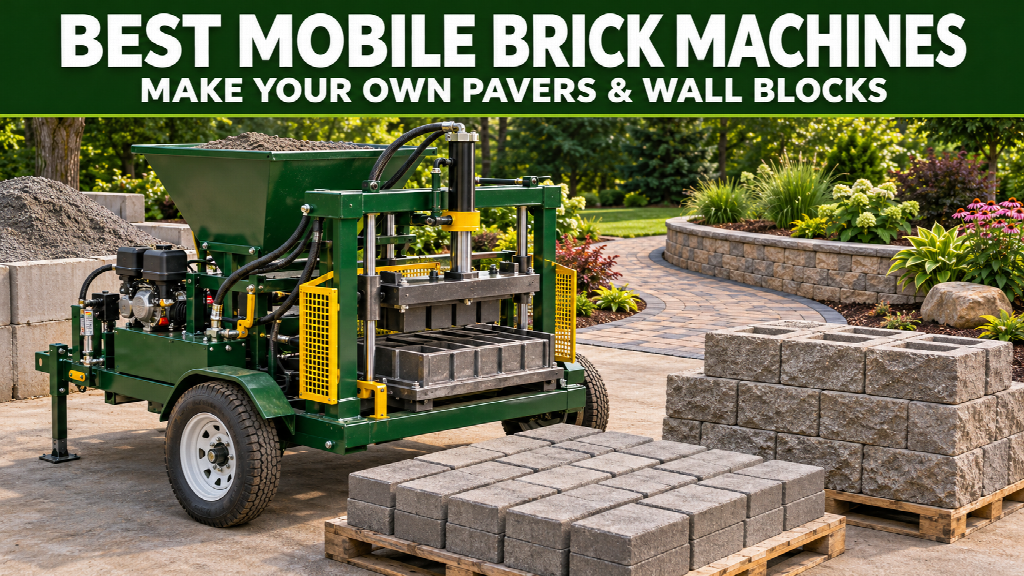
Semi-automatic models add engine-driven vibration and easier mold handling. Some run on a small diesel engine, so you can work on a remote property with no power hookup. If you need to move along a slab and set blocks straight onto the ground, a mobile brick machine does that without any steel or wooden pallets.
This group suits contractors who want steady output without a full block yard.
Hydraulic Automatic Mobile Machines
Larger mobile machines combine hydraulic pressure with vibration. Some move forward at the press of a button. They make far more blocks per shift, and denser ones. They also need a bigger slab, a mixer and a steady material supply.
Compressed Earth and Clay Brick Machines
These machines press damp soil or clay, often with some cement added, into interlocking bricks. Some small models sit on two wheels so one or two people can roll them across a site. Interlocking bricks suit garden walls, planters, seat walls and outbuildings. Test your soil first. Not every soil makes a strong brick.
Which Block Shapes Suit Landscaping Work?
Match the mold to the job before you buy:
-
Hollow blocks. Good for garden walls, planter walls and fence bases. You can fill the cores with gravel or grout and rebar where a design calls for it.
-
Solid blocks. Good for steps, low seat walls and footings for edging.
-
Edging and curb units. Useful for paths, beds and driveway borders. Check that the supplier offers the mold you need.
-
Interlocking bricks. Good for dry-stacked garden walls and raised beds.
-
Pavers. Most egg-laying machines are built for blocks, not thin pavers. Pavers usually need a pallet machine and a paver mold. Ask the maker which molds fit the machine before you plan around pavers.
One caution on retaining walls. Tall or load-bearing walls often need engineered units, a drainage layer and a design that meets local code. Home-made blocks suit garden-scale walls far better than structural ones. Get engineering advice for anything that holds back a slope near a house, driveway or property line.
Buying Criteria
Compare machines on these points:
-
Daily output you actually need. Count blocks per week across your real jobs. Do not buy for a best-case season.
-
Power on site. Choose diesel if your sites have no reliable electric supply.
-
Mold range. Confirm hollow, solid and edging molds, and ask whether custom sizes are possible.
-
Raw materials. Concrete machines can use sand, aggregate, fly ash, industrial by-products and even crushed old bricks. Clay machines use clay, soil, water and cement. Check what you can source locally.
-
Frame and mold steel. Molds wear fastest. Ask what steel they use and how replacement molds are supplied.
-
Training and support. Ask whether the maker gives installation help, operator training and mix ratio guidance.
-
Lead time and shipping. Build the build time and freight into your season plan.
LONTTO, for example, lists diesel and electric mobile models, offers raw material ratio guidance and training, and quotes a production time of 7 to 25 days depending on the model. Ask any supplier for the same details in writing.
Mixes, Curing and Site Setup
Good blocks need a consistent mix and patient curing:
-
Pour a level slab. Mobile machines lay blocks straight onto the ground, so the slab must be flat, smooth and clean.
-
Pick clean materials. Use sharp sand and small, clean aggregate. Avoid clay lumps, roots and organic matter in concrete mixes.
-
Keep the mix dry. Block mix is much drier than poured concrete. It should hold its shape when you squeeze a handful. Too wet and blocks slump; too dry and they crumble.
-
Run test batches. Make a small batch, cure it, and break a few blocks before you start full production.
-
Cure slowly. Keep fresh blocks out of direct sun and wind. Mist them and cover them with plastic sheeting. Concrete keeps gaining strength for weeks, so do not stack or sell blocks too early.
-
Plan for the weather. Do not make or cure blocks when frost is likely. In cold climates, block making is a warm-season job.
Space and Labor
Mobile machines save you from building a factory, but they still need room. Plan for:
-
A slab large enough for one day’s output plus curing space for the days before.
-
A covered or shaded curing area.
-
A stockpile area for sand, aggregate and cement, kept dry.
-
A water source for mixing and curing.
-
A mixer, or a lot of shovel work.
A small crew can run a manual machine. One person loads the mold, one runs the machine, and one keeps mix coming. Automatic models need fewer hands per block but more mixing capacity.
When Buying Beats Ordering Pallets
|
Buying a machine makes sense when |
Ordering pallets makes sense when |
|
You use the same shapes on many jobs |
You build a few patios a year |
|
Your sites are remote or hard to reach |
Delivery is fast and easy |
|
You have good local sand and aggregate |
Materials must be trucked in anyway |
|
Your crew has slow weeks to fill |
Your crew is fully booked |
|
You want plain wall blocks and edging |
Clients want colored, textured pavers |
|
Walls are garden-scale |
Walls are tall, structural or engineered |
Frequently Asked Questions
Can a mobile block machine make pavers?
Most mobile egg-laying machines are built for hollow and solid blocks. Thin pavers usually need a pallet machine and a paver mold. Ask the maker which molds fit the model you are considering.
How long before I can use the blocks?
Blocks can be moved gently once they hold together, but they need to cure for weeks to gain strength. Keep them damp and shaded, and test a few before using them in a wall.
Can I use soil from my own property?
For a compressed earth or clay brick machine, possibly. Test the soil first. For concrete blocks, use clean sand and aggregate rather than site soil.
Bottom Line
A mobile block machine can help a busy landscaper or large-property owner make wall blocks and edging on site. Start with the products you use most, the power on your sites and your space. Run test batches, cure with patience, and keep structural retaining walls in the hands of engineered products. If most of your work is a few patios a year, keep ordering pallets.